
Re-post with correction
Re-post with correction
For this seventh and final essay of this series, I return to the revised definition of spiritual activism I offered in essay two.
Spiritual activism: Intentionally reforming (i.e., challenging to the status quo/business as usual) words and actions for the common good (and/or justice for vulnerable and/or oppressed people, animals, nature, etc.), informed and inspired by a growing understanding (and possibly direct experience) of the ultimate unity of all life coupled with an intensifying inner love for others, life, and the Spirit of Life (i.e., God, Ground of Being, Universal Love, Divine Light, etc.) AND, over time, a deep healing/ liberation/recovery from destructive habitual patterns, in part, by regular, consistent, long-term spiritual practices.
Yes, there is a lot to work with in this definition of spiritual activism. Thus, I invite you to read and reread it aloud, slowly. With that working definition refresh, let us also return to Dante’s Divine Comedy. You may recall that Dante began his journey lost in the dark woods until Virgil arrived and offered him guidance to the Mount of Joy visible in the distance but blocked by three beasts (see essay #5).
With Virgil’s guidance as well as much inner work along the way, Dante makes his way from the dark woods to a bright green, light filled forest, the final level of Purgatory, the Garden of Earthly Paradise where Virgil crowns him the lord of himself (i.e., self-awareness & self-mastery). As Vernon highlights, Dante’s motivation is now pure; his will correctly oriented, and his heart is free to love fully and genuinely. Virgil then bids Dante farewell and departs as reason has taken Dante as far as it can to the border of Paradise (i.e., the transformation/union phase of the spiritual journey). Beatrice (symbol of love) enters the story and becomes his primary guide into Paradise (Note: I am barely scratching the surface of this timeless classical masterpiece. I encourage you to explore it directly yourself along with the assistance of Vernon’s Dante’s Divine Comedy: A Guide for the Spiritual Journey and/or Dante’s Road: The Journey Home for the Modern Soul by Marc Thomas Shaw).
As beautifully illustrated in Dante’s Divine Comedy, the transformative/union phase of the “3-Fold Way” necessitates a letting go of rational understanding; a dropping of preconceived notions and an opening of mind to more unitive ways of knowing while also surrendering to the flow of divine intelligence and energy. From my limited understanding of Taoism, we could also refer to this as wuwei or entering a state of active receptivity. In this state of active receptivity, we open ourselves to the flow of life energy or life force (aka, Holy Spirit, ruach, shakti, chi, etc.) and to the fresh inspirations or movements of the soul that may arise as we surrender our personal agendas.
It is important to note that this is a practice of a lifetime that requires discernment and humility, self-honesty, and openness to feedback themes (Note: If multiple people provide similar feedback, there may be something there to examine). It is also helpful to observe the impact actions have on others—unifying or divisive, helpful or hurtful, constructive or destructive? However, most if not all the systems of self-transformation I have studied and worked with directly emphasize the need for detachment to specific outcomes or results. In other words, assuming good intentions, right effort, and an authentic discernment process, we follow the inspirations and “we let go and let God.” It is critical to reemphasize the necessity for regular self-observation and examination of conscience, in addition to engaging in reality checks with a trusted friend, coach, or spiritual director. Humans have blind spots, shortcomings, and biases. We are all a work in progress! We are going to fail and fall, repeatedly; however, that is the path of healing, maturation, and transformation.
I am going to conclude this series on the topic of spiritual activism with this final essay even though there is much I have not covered adequately. Therefore, if you have not yet chosen a holistic and comprehensive system of self-transformation, please do so before moving on from this essay and series, because as highlighted by Brant Cortright in his book, Psychotherapy and Spirit, “People generally think of the spiritual path as safe-if not easy, then at least a protective haven from the existential insecurity of life, a soothing balm from the inevitable anxieties, fears, and pain of living. But like any great endeavor, the spiritual journey also has its risks and dangers.”
We live in amazing times with the world’s wisdom traditions at our fingertips; however, simply reading these essays or a book or two on spirituality will have little value. The value comes from adopting a way of life that nurtures healing, maturation, wholeness, and transformation over the course of a lifetime. Happy travels fellow sojourner and spiritual activist! Our world needs YOU!
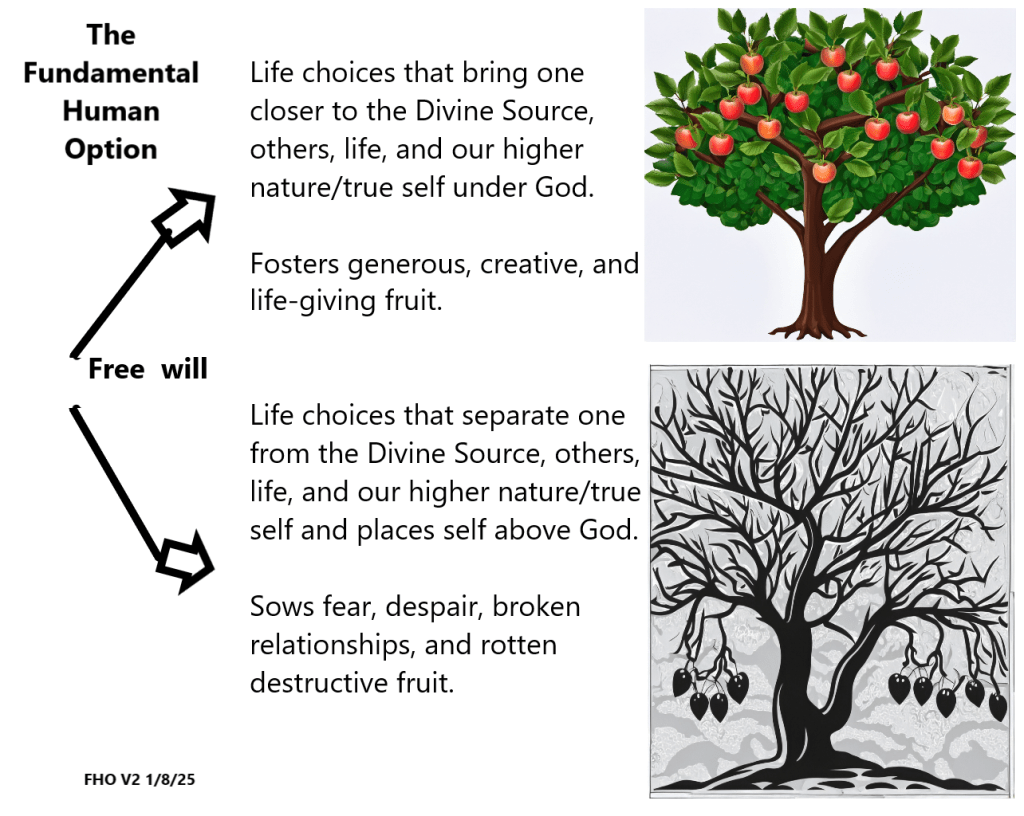
As we continue our journey deeper into spiritual activism, we pick up the sixth essay of this series with where we left off—replacing vices with virtues and the process of reorienting one’s being to the good, the true, and the beautiful. As I currently understand it, the good, true, and the beautiful are the common philosophical categories representing the highest expression of being within the three dimensions of the human psyche or soul—the will, the mind, and the emotions and thus in turn, in and through life lived, individually and collectively.
Individual ideals or virtues can be ordered within one of these three primary categories. Thus, as we work to reorient our being and lives in the direction of our ideals, choice by choice, day by day, it is essential to maintain honest awareness of where we are in the present (Note: Most of us need a spiritual director, friend, and/or community to help us as we can easily deceive ourselves here). All the progress made in the initial phases of our healing and maturing work provides a solid foundation of self-awareness which continues to reveal our character flaws, strengths, emotional wounds and vulnerabilities, gifts, and habitual patterns more clearly and allows us to compassionately examine how they influence and shape our lives and our happiness (Friendly reminder: This is a not a linear process but a life-long, iterative, ripening of being).
Our growing self-awareness sheds light on which of “the three beasts” (i.e., the symbols used in Dante’s DC to represent the gates of the cardinal vices highlighted in Essay 5) is the most predominant inner obstacle to our reorientation of beingness. As we start to “connect the dots” of our inner world, we can select spiritual practices most suited for facilitating ongoing deep change (i.e., reorientation).
For example, in the spiritual literature, fasting is often encouraged as an essential core practice for “lust of the flesh” (sexual lust, gluttony, and sloth); tithing and charitable giving to include money, possessions, and volunteer service for “lust of the eyes” (greed and worldly sorrow), and prayer and meditation or contemplation for “lust of life” (wrath, envy, and spiritual pride).
It is important to reemphasize that across the world religions prayer and meditation or contemplation are essential core practices for all of us seeking to heal, mature, and transform in service to a higher common good (see chart below). There are many excellent resources, spiritual and religious, available to help inform and guide one’s selection of spiritual practices to include Richard Foster’s classic Christian guidebook, “Celebration of Discipline” and those cited in my book, Ten Developmental Themes of Mindful Leaders, Table 5.1.
| Wisdom Tradition | Examples of Transformative Practices Associated with Wisdom Traditions of the West | ||||
| Christianity-Inner | Lectio Divina (sacred reading) | Centering Prayer (meditation) | Contemplation | Prayer | Service |
| Islam-Sufism | Chanting | Prayer | Breathing Exercises | Music & Dancing/Whirling | Meditation |
| Judaism-Kabbalah | Study of the Torah, Talmud, the Zohar and other sacred texts | Meditation | Prayer | Pilgrimages to Holy Places | Shabbat/Sabbath |
Table Source: Frizzell, Denise (2018). Ten Developmental Themes of Mindful Leaders.
As stated previously, initially, and potentially for a significant period, reorienting to the good, the true, and the beautiful may feel like an inner battle. However, each time we reject a habituated destructive choice (a vice) for a desired good (a virtue or ideal), we are strengthened in our efforts by a budding inner aliveness, sense of freedom, and happiness, as well as improving interpersonal relationships, and growing life satisfaction. Over time, we experience a growing ease or disposition for the good, true, and beautiful coupled by a simultaneous increasing distaste for our old harmful habits.
Furthermore, as we reorient more into our new, higher selves, we may notice an increasing sense of unity with other people, nature, and overall LIFE as well as an expanding love for self (not as in the selfishness of our old, false self but as in a growing dignity and self-respect), for other people, nature, and God/Spirit/Divine Source, which readies us for entering into the transforming phase of our journey to spiritual activism –receiving and responding to the movements of inspiration for the well-being of others and the common good.
To be continued.
How can we relax and have a genuine, passionate relationship with the fundamental uncertainty, the groundlessness of being human?
Pema Chödrön
In 1989, business scholar, Peter B. Vahil coined the phrase, “permanent white water” to describe the changing business environment. Vahil may have been foreseeing life in the 21st century in as the management and leadership literature recently adopted the military acronym, VUCA (volatile, uncertain, complex, and ambiguous) to describe the global environment. Furthermore, management guru Gary Hamel frequently reminds his audiences that the “nature of change is changing.”
Consequently, a growing body of leadership literature emphasizes the importance for leaders to enhance their tolerance for uncertainty or ambiguity. For example, leadership scholars Ron Heifetz, Alexander Grashow, and Marty Linsky’s propose that adaptive leadership is critical given the reality of VUCA. Heifetz and his colleagues argue that “diagnostic failure” is at the root of humanity’s inability to solve our most pressing challenges. They argue that leaders are approaching humanity’s unprecedented global challenges as technical challenges, challenges with knowable solutions.
However, as evident in the repeated failure of technical solutions, the challenges humanity faces are adaptive challenges. Adaptive challenges are beyond current individual and collective knowledge, capacity, and expertise. Therefore, they require higher psychological maturity, as well as capacities and competencies that many, if not most, leaders have not yet developed.
This developmental gap makes leaders and the organizations they lead vulnerable to costly missteps, performance declines, and legitimacy losses. While the literature purporting the necessary competencies for effective global leadership is vast, three comprehensive categories, highly related to the capacity to tolerate uncertainty, frequently emerge: perception management, relationship management, and self-management. Furthermore, a growing body of mindfulness scholars have indicated positive correlations between these three comprehensive categories and MBIs which my research on mindful leaders supports.
And I think in the past I probably would have made a much quicker perhaps more decisive decision in the moment and not embraced that time of interim or uncertainty. So I think mindfulness allowed me to do that and to say ‘it’s okay not to have all the answers right now,’ and let it kind of be. (Male middle manager in the health care industry)
I think embracing that sense of adventure, that sense of adventure and sometimes adrenaline that I had been avoiding [with] people sometimes …because I associated it with maybe danger or risk, but now being much more comfortable living on that leaning-toward perspective as opposed to kind of leaning on the safe side of the fence. (Male middle manager in the health and wellness industry)
Thus, mindful leaders experience a growing tolerance for uncertainty and ambiguity which supports them not only in their work roles but in all areas of their lives. The VULA environment appears to be here to stay for the foreseeable future, perhaps intensifying. Thus, the critical decision we each face is whether we will attempt to navigate the white waters of our lives in the boats we have or start building stronger boats.
This essay is an excerpt from my forthcoming book, Ten Developmental Themes of Mindful Leaders with an expected publication of October-November 2018.
 “Self-aware leaders are attuned to their inner signals. They recognize, for instance, how their feelings affect themselves and their job performance. Instead of letting anger build into an outburst, they spot it as it crescendos and can see both what’s causing it and how to do something constructive about it.” Daniel Goleman, Richard Boyatzis, & Annie McKee in Primal Leadership: Learning to Lead with Emotional Intelligence
An ancient teaching of philosophy and the wisdom traditions to, “know thyself” speaks to the significance of leader self-awareness, an element of emotional intelligence (EQ). EQ represents a developmental concept, supported by a weighty body of research, that examines “how should I feel about this?”
The interest in EQ has been growing in popularity and influence since 1995 when Daniel Goleman published his seminal book based primarily on the research findings of scholars, Peter Salovey and John Mayer. Since that time, thousands of research papers and hundreds of books on the topic have been published. While a trendy and popular topic of the leadership literature for years, EQ and its four elements (self-awareness, self-management, social awareness, social management) are as relevant today, if not more so, when it comes to leader effectiveness in our ever increasing VUCA environment.
The good news is that the ten developmental themes that emerged from my research (and my experience as a meditation practitioner for the last seven years) reinforce the growing understanding that mindfulness meditation can and does cultivate self-awareness and EQ in general. Without self-awareness, leaders are inclined to react from unconscious habitual patterns of thought, word, and actions (i.e., blind spots) that often have negative impacts on the work environment. The more blind spots leaders have, the more at risk they are for costly missteps.
Greater self-awareness provides the “inner-space” one needs to notice sensations and see thoughts arising within and to choose a constructive response over a destructive reaction. Expanding self-awareness also typically evolves into the capacity to comprehend more complexity, which naturally involves a transition toward a more inclusive self-identity. Consequently, greater self-awareness translates into more intentional leading and living over time as illustrated in voices of these mindful leaders.
So, it (mindfulness practice) has helped me to notice how I am in relationship and how I come across. It has helped me to continue to refine how I am with others so that I can work better with people. It has helped me to manage conflict with people when there is conflict. It’s helped me to just kind of have a better sense of my strengths and weaknesses and how to bring that into meetings and working with the team. (Female middle manager in the personal-development industry)
So through self-awareness, I take a bigger picture approach, so I’m more open to what they (more senior leaders) are wanting to achieve and I can see the bigger context of why decisions are made. And in direct relationship experiences with superiors, I find that I’m more…probably more balanced, more open to discussion as well and having more confidence in myself and belief in my ability as a leader and manager of a group then I can integrate with persons of a higher authority and I’m not feeling challenged or inferior. I can see, not necessarily as an equal in status or rank, but an equal as a person to person kind of thing…discussing the ideas and then making it happen, so that’s been a definite change in me. (Male administrator higher education)
Thus, mindful leaders are more attuned to their inner worlds through growing self-awareness that makes a positive and powerful difference not only in their formal leadership roles but in all areas of their lives. This developmental theme of mindful leaders and the nine others that emerged from my research, as well as my own life-experience, support the transformative potential of mindfulness meditation. So, what are you waiting for? Try mindfulness meditation for yourself and begin reaping the developmental fruits associated with an active, consistent, and persistent practice (i.e., the path of mindfulness meditation is a PATH, a very rich one, but it is not a quick fix).
Note: This essay is an excerpt from the forthcoming book, Ten Developmental Themes of Mindful Leaders by Denise Frizzell, Ph.D.

Freedom is not the absence of commitments, but the ability to choose – and commit myself to – what is best for me. Paulo Coelho in The Zahir
Modern neuroscience is illuminating humanity’s understanding of the nervous system including the human brain and the evolutionary discovery that the human adult brain has a quality of neuroplasticity, the ability to change. This ability to change permits rewiring of the neural pathways or circuits established by longtime habitual cognitive-emotional-behavioral patterns throughout the entire lifespan.
It is difficult to emphasize the significance of this finding (and numerous others), because it undercuts a paradigm historically held by scientists and mental health professionals that the human brain becomes “hardwired” in childhood. Thankfully, humans can and do rewire our brains and form new habits throughout our lives which is extremely good news for individuals, organizations, and humanity’s collective future!
Despite the good news of neuroplasticity, we all know that changing longtime habitual patterns is not easy. This is in part due to our highly efficient human brains that naturally seek to conserve energy by autopiloting repetitive thoughts-emotions-action loops so as to free up cognitive capacity for new, creative, and more complex endeavors.
However, a growing body of scientific findings on meditation and the brain indicate that practices such as mindfulness meditation support the replacement of self-defeating habits with more constructive habits (to include meditation itself!) while also facilitating structural changes that enhance well-being. The mindful leaders in my 2015 doctorate study demonstrated the capacity of the adult brain to rewire neural pathways and form development-oriented habits through a commitment to their mindfulness practice as depicted in the following example.
And when I don’t practice, I miss it. I long for it, and I feel, it helps being married, having a barometer [laughs] that lives with you. Who says, ‘Has it been a couple of days since you sat?’ ‘Or a couple of weeks, perhaps?’ You know, ‘What’s going on?’ And, usually he doesn’t have to say that. Usually just my own reactivity speaks to me, his responses to me speak to me that show me that I’m off base. And I do miss it and it was profound for me when I realized that meditation is like food. It’s nurturing. So, there’s no longer the hammer of a should, if I don’t practice there will be negative consequences. It’s more that I really long for my own sanity I think.
Thus, the mindful leaders studied appear to be experiencing the fruits of their practices and the promise of neuroplasticity. They are freeing themselves from unproductive habitual patterns and choosing new constructive habits for better (and more sane) lives to include commitment to their meditation practices. For more information on the good news of neuroplasticity and additional (r)evolutionary findings in the realm of neuroscience and meditation, check out “Buddha’s Brain” by Rick Hanson, Ph.D.
This essay is an excerpt from the forthcoming book, Ten Developmental Themes of Mindful Leaders by Denise Frizzell, PhD, Holistically-Oriented Transformative Coaching and Management Consulting (http://www.metamorphosisconsultation.com).
Revised 7/12/2017
 While there is no universal definition of leadership, popular definitions often include a reference to power and influence that shape or inform others’ thinking and acting. In Western societies, particularly the United States, leadership is highly associated with traditional masculine qualities such as assertion, control, achievement, competition, and material success. In other words, leaders are typically rewarded for doing.
In contrast, in the United States, traditional feminine qualities such as receptivity, cooperation, relationship-orientation, humility, and harmony have historically been deemphasized in leadership and the workplace. While this is starting to change (i.e., the growing recognition of the importance of these qualities in leadership effectiveness), the emphasis is still overwhelmingly on doing.
Consequently, today’s organizational manager-leaders report long hours and high demands that leave them overstretched, depleted, and disconnected. Consequently, the modern organizational manager-leader often lives an extremely unbalanced life with work consuming most of their days (and nights) with minimal time available for self-care, family time, spiritual renewal, or community engagement.
Overtime, this takes an immense toll on manager-leaders on many levels as they start “killing the goose” as illustrated in the wisdom of the Aesop Fable, The Goose that Laid the Golden Egg:
A man had a hen that laid a golden egg for him each and every day. The man was not satisfied with this daily profit, and instead he foolishly grasped for more. Expecting to find a treasure inside, the man slaughtered the hen. When he found that the hen did not have a treasure inside her after all, he remarked to himself, ‘While chasing after hopes of a treasure, I lost the profit I held in my hands!’
Ideally, manager-leaders make positive life changes before “slaughtering the hen.” Unfortunately, it often takes a significant crisis before a manager-leader recognizes the self-destructive path she/he is on. However, the first developmental theme of the mindful leaders in my study indicates that the growing interest in and practice of mindfulness based interventions (MBIs) by an increasing numbers of manager-leaders is resulting in a potential shift toward greater balance in their approach to leadership as depicted in the following example.
I guess another thing that changed for me is I’m starting to kind of shift my views on decision-making. And, so I mean that’s the primary role of a leader, right, is to make decisions about certain things. And I used to sit there and agonize, ‘Oh, well, what’s the right decision? What’s going to, you know, satisfy this criterion or, you know, make this person happy or, you know, achieve this goal or whatever?’ And I still kind of do that, but now I’m shifting a little bit more towards letting go of that process a little bit. It’s not that I don’t make a decision. It’s that I see the decision as kind of emerging on its own, which is a little bit strange, but again, it ties back to that aspect of, you know, the not sell or, you know, not (over) identifying. (Middle manager and academic in higher education)
Thus, a more integrated or balanced leadership style was the first and most represented theme of the mindful leaders studied followed by greater self-regulation, the topic of my next blog essay.
This essay is an excerpt from my forthcoming book, Ten Developmental Themes of Mindful Leaders with a projected publication of December 2017.
 As painfully apparent in the news from around the globe (to include news related to America’s uber-bizarre presidential campaign), severe global challenges (e.g., climate change, global terrorism, inequality, etc.) threaten our quality of life and the life of future generations. Furthermore, traditional approaches to social, economic and political life are breaking down and are no longer adequately fulfilling the purposes for which they were established (e.g., U.S. education, healthcare, etc.).
However, our global challenges may also be viewed as evolutionary drivers pressing humanity to reimagine and recreate systems from agricultural to transportation from a more holistic understanding of our growing interdependence on a highly stressed planet with an increasing population (the U.N. projects a worldwide population of 9.7 billion by 2050). Consequently, we stand at an evolutionary crossroads that demands conscious and responsible leadership at every level and sector of society.
Conscious leadership necessitates taking a deep dive into questions of identity, values, and mindset. Identity questions examine how a person defines oneself and views his/her relationships or with others and our planet. Value questions explore what a person honors and holds dear in life, which often underlies desire and motivation. Mindset addresses the worldview in which a person makes sense of the world (i.e., our lens of interpretation) and from which action arises, knowingly or unknowingly. Therefore, conscious leadership refers to awareness and appreciation of one’s inner and outer world and the influence they have in his/her life choices, well-being, relationships, and life conditions.
Responsible leadership arises from an expanding and more inclusive identity and global mindset that includes a growing sensitivity and valuing of one’s interdependence with others and the entire earth community. Consequently, desire and motivation arise within the responsible leader to make ethical decisions.
Thus, conscious and responsible leadership directly responds to the evolutionary need of a global ethic. A genuine global ethic demands responsibility to people, place, and planet such that all forms of social systems to include economic systems are held to the standard of providing a reasonable quality of life for all citizens which includes a degree of employment security, material security, a stable family and community life, and environmental sustainability as emphasized by a growing number of diverse voices to include author and Boston College professor Juliett Schor.
Conscious and responsible leaders across the sectors are engaging in the work of transforming themselves and their organizations to minimally, reduce the harm caused by operations, and ideally, provide solutions to the numerous social and environmental challenges that threaten humanity’s quality of life for current and future generations.

These last few weeks have me dazed and confused. No doubt, we live in uncertain and complex times. It seems that life, as we know it is in a major state of flux and flurry. We face unprecedented challenges to our quality of life and the lives of future generations such as global climate change, gun violence, growing inequality, global terrorism, and mass extinction of species, just to name a few.
Given the scale of our collective challenges, leaders are called to “show up” with their gifts, talents, and resources and ask, “How can I contribute to real solutions that address the global challenges most concerning and meaningful to me? Real leadership and real solutions call us into our higher natures. It does not separate, rouse hate against some “evil other,” nor play to our animalistic fears. Consequently, real leadership and real solutions necessitate a global mindshift, because underlying all our mayhem is a separation consciousness that operates from an either/or mindset.
As Einstein and many others have stated, we cannot and will not solve our most pressing challenges with the same thinking that created them. Consequently, solving our most urgent global challenges requires a global mindshift to more holistic thinking and acting. However, holistic or integral thinking does not mean that everything is equal. It requires movement from either/or thinking to both/and thinking as well as discernment of breadth and depth.
Ideally, as highlighted by American philosopher Ken Wilber and numerous other thought leaders (e.g., Warren Bennis) a holistic or integral mindset needs to include the individual “I” or subjective, the collective “we” or cultural, and the collective “it” or systems (social and natural) dimensions. Leaders have a unique opportunity and responsibility to help midwife this essential global mindshift at every level of society. While there are numerous areas demanding more holistic thinking, for this essay, I would like to focus on one critical issue on many hearts and minds, gun violence.
Gun violence tragedies are ravaging our lives in increasing numbers. Approximately 30,000 Americans die from gun violence annually (www.americansforresponsiblesolutions.org). A holistic or integral mindset would require questions and solutions from the four basic areas highlighted above. For example, possible questions include:
Gun violence in America is a complex and difficult issue, and I do not claim any expertise here. However, like many Americans, I am deeply troubled by our current gun violence crisis, and I offer these questions as a starting point. Furthermore, I yearn for real leadership and real solutions on this issue, which I propose will only come about through a global mindshift to more holistic thinking and acting.
Consequently, 21st century leadership requires a global mindshift from either/or thinking to BOTH/AND thinking. Sounds good, but how do leaders go about making this type of perspectival shift? This is THE question of personal transformation for which there are no easy and definitive answers. However, we start where we are and begin the transformative journey toward psychological maturation or self-actualization and awakening (please see the essay, Waking, Up, Growing, Up, and Showing Up). There are numerous transformative practices, East and West, to help facilitate this global mindshift. However, presently meditation is the most evidence-based transformative practice available. Furthermore, the power of meditation is enhanced with a wellness lifestyle that honors body, mind, spirit in self, society, and nature. Yes, this is a tenuous and lifelong journey, but it promises to be the greatest adventure one will ever take!
Revised 1/13/20
 The prolific American philosopher and Integral theorist, Ken Wilber, is fond of stating that Integral Theory (his noteworthy contribution toward a “theory of everything” ) is ultimately about waking up, growing up, and showing up. The direct, simple, and profound truth of his statement deeply resonates with me in my personal journey and as a leadership scholar and consultant who views this (i.e., waking up, growing up, and showing up) as the leadership imperative of the 21st century.
Waking up speaks to the urgent need for leaders to reconnect with their spiritual nature or essence. As spiritual teachers gently remind us, we are spiritual beings having a human experience not human beings with an occasional spiritual experience. However, for a variety of reasons including our fast-paced and highly stimulated lives, many of us have lost connection with this deeper dimension of our being. The spiritual realm of human experience concerns our ultimate nature and relationship to self, all sentient beings (people and creatures), our planet, and all that is—seen and unseen for which there are many names (e.g., Spirit, God, Jehovah, Allah, Goddess, Universe, Source, etc.). Consequently, the leadership imperative to wake-up involves slowing down and quieting the mind to befriend one’s innate wisdom, the still small voice that knows who you really are. This reunion requires ongoing cultivation and nurturing. Thankfully, there are many spiritual practices such as meditation and prayer to support our continued awakening. Spirituality and Practice (www.spiritualityandpractice.com ) is an excellent resource containing practices from many different traditions.
Growing up refers to the leadership imperative for psychological and emotional maturity. While I certainly do not make any claims here (or in any realm of this imperative), over the last six years, I have wholeheartedly contemplated what it means to be a healthy and mature human being. In so doing, I have engaged in deep personal work (e.g., meditation, self-observation, coaching, counseling, etc.), and read numerous related books (e.g., The Places that Scare You by Pema Chödrön, Guide to Rational Living by Ellis & Harper, and I’m Okay, You’re Okay by T. Harris). Consequently, I have come to see that one key element of being and becoming a healthier and mature adult and leader is accepting full and complete responsibility for one’s life. It also includes the difficult work of facing one’s shadow (see essay, Leader Self-Development and The Necessity of Shadow Work). While personal responsibility and shadow work take courage, patience, and compassion, it is at the heart of growing up.
Lastly, but certainly not least, showing up. Showing up (what leaders tend to do best!) refers to the imperative to be and become part of the solution to the numerous unprecedented global challenges that threaten the quality of our lives and the lives of future generations. These challenges (e.g., terrorism, climate change, economic uncertainty, gun violence, etc.) call leaders to access more of their potential (through ongoing inner work) then to show up as their unique authentic selves to contribute real solutions to humanity’s global challenges.
The leadership imperative of the 21st century—waking up, growing up, and showing up. What do you think? I think it sounds a little scary. However, American Buddhist nun and author, Pema Chödrön, encourages folks to start the inner journey where they are. This is good advice, advice, which I will heed as I clumsily walk this path called my life and accept this invitation, however imperfectly. Will you join me?
(Revised and reposted 6/17/2016. Previous version posted on former blog, Paradigms4Progress).

 Metamorphosis