
As we continue our journey to spiritual activism, we pick up the fifth essay of this series with where we left off–releasing the charge of an emotional trigger and replacing a habituated destructive reaction (or vice) with a fresh life-affirming response (or virtue). As repeatedly stated, this is much easier to talk about than actualize. Thus, please be compassionate and patient with yourself when you repeatedly fall short. The key point is to continue the full practice (i.e., all core elements of an integrative/holistic/integral life practice (see Essays 1-4 of this series) because over time, with right effort, diligence, and practice, you will feel interior shifts and experience changes in your life and relationships.
It is important to reiterate that while “right effort” is an obvious essential dimension of the inner journey, it is only a part of the sacred mystery of “deep change” along with the paradoxical surrendering of the will (e.g., Step 1 of the Twelve Steps). Coupled with right effort and surrender of self-will is the incomprehensible “Infinite Spirit of Love, Light, and Life” known as Grace in the Christian tradition, freely and generously bestowed upon us as we authentically turn away from destructive ways of being and toward life-affirming ways of being.
Now let us return to Dante’s Divine Comedy (DC) as you may recall that my study of this classical work with the help of guide, Mark Vernon, inspired my decision to embark on this essay series. You may also recall that Dante begins his journey by finding himself lost in the woods:
Midway in our life’s journey, I went astray
from the straight road and woke to find myself
alone in the dark wood.
Shortly after this realization, he lifts his eyes and sees the sun rising which fills him with joy and hope, so he starts toward the mountain he sees in the distance. However, he is suddenly stopped in his tracks by three beasts. While commentaries may differ here, these three beasts are often noted as symbols of the gates of the cardinal vices–lust of life (the lion of wrath, envy, and pride), lust of the eyes (the leopard of greed and worldly sorrow, and lust of the flesh (the wolf of sexual lust, gluttony, and sloth). The three beasts stop Dante in his tracks until his guide, Virgil (a symbol of reason) shows up to support and guide him through Hell then Purgatory as there is no direct ascent up the mountain (the Mount of Joy) and past the three beasts toward the desired destination, the mountain peak of joy (Paradiso).
Dante orients his journey and the first two parts of the DC around the Cardinal Vices and Virtues associated with ancient Greek Philosophy and Christianity. While world religions and philosophies differ in beliefs, doctrines, and practices, there are more similarities than differences amongst them in the realm of desirable character traits of followers or ways of relating and living in society (i.e., virtues).
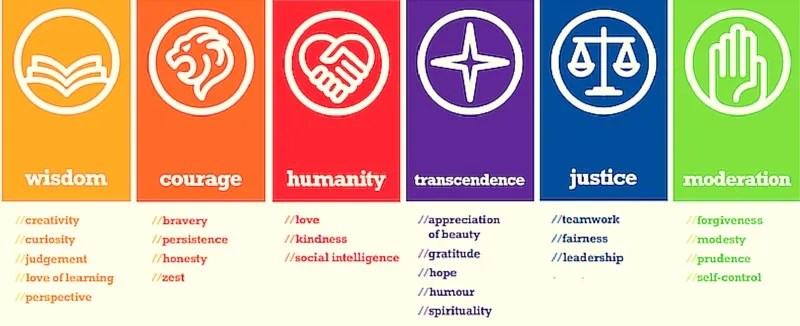
Martin Seligman, American psychologist, author, educator and founder of positive psychology, and fellow researchers in the field studied major religions and philosophical traditions and identified six virtues (see image below) common to cultures across the ages.

(Source: https://positivepsychology.com/classification-character-strengths-virtues/)
Over time (yes, much time—no quick fix here), as we genuinely seek to replace vices with virtues, we slowly become reoriented to new, higher ways of being human. This reorientation then begins to infuse our activism, and overall life, with greater wisdom, justice, courage, humanity, transcendence, and moderation while opening us further to the transformative power of Divine Love, Light, and Life or the Good, the True, and the Beautiful, the three core domains of philosophy and religion.
To be continued.




 Metamorphosis