
Re-post with correction
Re-post with correction
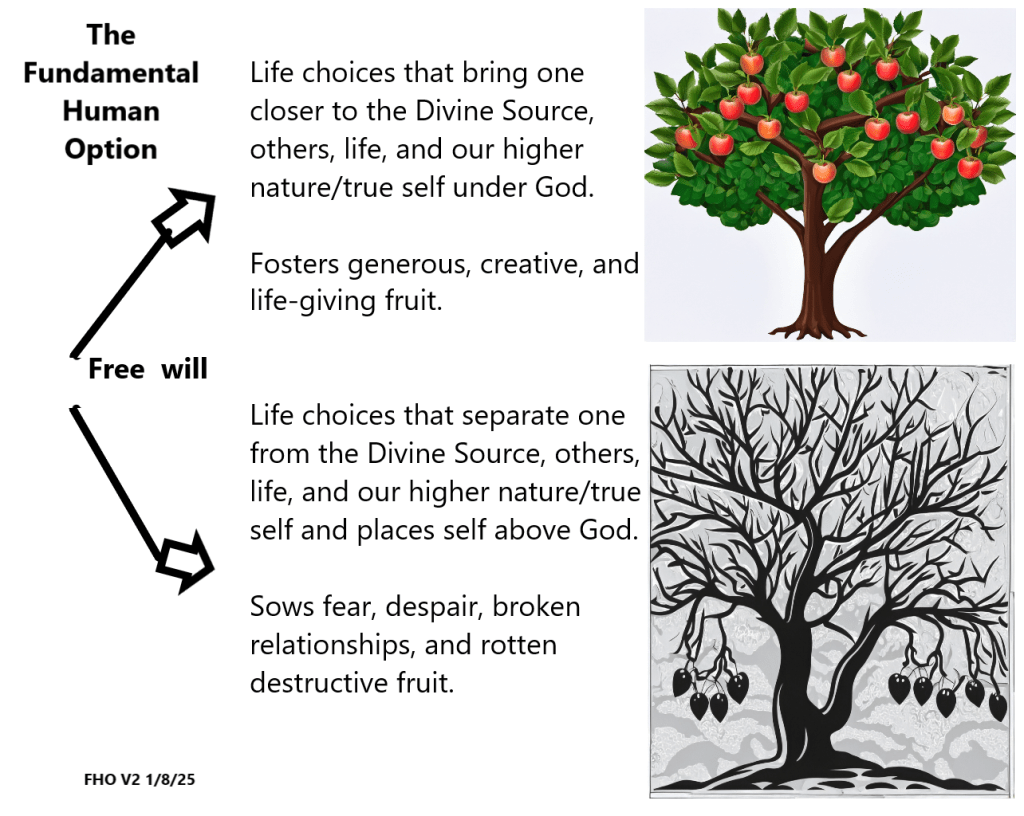
As we continue our journey deeper into spiritual activism, we pick up the sixth essay of this series with where we left off—replacing vices with virtues and the process of reorienting one’s being to the good, the true, and the beautiful. As I currently understand it, the good, true, and the beautiful are the common philosophical categories representing the highest expression of being within the three dimensions of the human psyche or soul—the will, the mind, and the emotions and thus in turn, in and through life lived, individually and collectively.
Individual ideals or virtues can be ordered within one of these three primary categories. Thus, as we work to reorient our being and lives in the direction of our ideals, choice by choice, day by day, it is essential to maintain honest awareness of where we are in the present (Note: Most of us need a spiritual director, friend, and/or community to help us as we can easily deceive ourselves here). All the progress made in the initial phases of our healing and maturing work provides a solid foundation of self-awareness which continues to reveal our character flaws, strengths, emotional wounds and vulnerabilities, gifts, and habitual patterns more clearly and allows us to compassionately examine how they influence and shape our lives and our happiness (Friendly reminder: This is a not a linear process but a life-long, iterative, ripening of being).
Our growing self-awareness sheds light on which of “the three beasts” (i.e., the symbols used in Dante’s DC to represent the gates of the cardinal vices highlighted in Essay 5) is the most predominant inner obstacle to our reorientation of beingness. As we start to “connect the dots” of our inner world, we can select spiritual practices most suited for facilitating ongoing deep change (i.e., reorientation).
For example, in the spiritual literature, fasting is often encouraged as an essential core practice for “lust of the flesh” (sexual lust, gluttony, and sloth); tithing and charitable giving to include money, possessions, and volunteer service for “lust of the eyes” (greed and worldly sorrow), and prayer and meditation or contemplation for “lust of life” (wrath, envy, and spiritual pride).
It is important to reemphasize that across the world religions prayer and meditation or contemplation are essential core practices for all of us seeking to heal, mature, and transform in service to a higher common good (see chart below). There are many excellent resources, spiritual and religious, available to help inform and guide one’s selection of spiritual practices to include Richard Foster’s classic Christian guidebook, “Celebration of Discipline” and those cited in my book, Ten Developmental Themes of Mindful Leaders, Table 5.1.
| Wisdom Tradition | Examples of Transformative Practices Associated with Wisdom Traditions of the West | ||||
| Christianity-Inner | Lectio Divina (sacred reading) | Centering Prayer (meditation) | Contemplation | Prayer | Service |
| Islam-Sufism | Chanting | Prayer | Breathing Exercises | Music & Dancing/Whirling | Meditation |
| Judaism-Kabbalah | Study of the Torah, Talmud, the Zohar and other sacred texts | Meditation | Prayer | Pilgrimages to Holy Places | Shabbat/Sabbath |
Table Source: Frizzell, Denise (2018). Ten Developmental Themes of Mindful Leaders.
As stated previously, initially, and potentially for a significant period, reorienting to the good, the true, and the beautiful may feel like an inner battle. However, each time we reject a habituated destructive choice (a vice) for a desired good (a virtue or ideal), we are strengthened in our efforts by a budding inner aliveness, sense of freedom, and happiness, as well as improving interpersonal relationships, and growing life satisfaction. Over time, we experience a growing ease or disposition for the good, true, and beautiful coupled by a simultaneous increasing distaste for our old harmful habits.
Furthermore, as we reorient more into our new, higher selves, we may notice an increasing sense of unity with other people, nature, and overall LIFE as well as an expanding love for self (not as in the selfishness of our old, false self but as in a growing dignity and self-respect), for other people, nature, and God/Spirit/Divine Source, which readies us for entering into the transforming phase of our journey to spiritual activism –receiving and responding to the movements of inspiration for the well-being of others and the common good.
To be continued.
As we continue our journey to spiritual activism, we pick up the fifth essay of this series with where we left off–releasing the charge of an emotional trigger and replacing a habituated destructive reaction (or vice) with a fresh life-affirming response (or virtue). As repeatedly stated, this is much easier to talk about than actualize. Thus, please be compassionate and patient with yourself when you repeatedly fall short. The key point is to continue the full practice (i.e., all core elements of an integrative/holistic/integral life practice (see Essays 1-4 of this series) because over time, with right effort, diligence, and practice, you will feel interior shifts and experience changes in your life and relationships.
It is important to reiterate that while “right effort” is an obvious essential dimension of the inner journey, it is only a part of the sacred mystery of “deep change” along with the paradoxical surrendering of the will (e.g., Step 1 of the Twelve Steps). Coupled with right effort and surrender of self-will is the incomprehensible “Infinite Spirit of Love, Light, and Life” known as Grace in the Christian tradition, freely and generously bestowed upon us as we authentically turn away from destructive ways of being and toward life-affirming ways of being.
Now let us return to Dante’s Divine Comedy (DC) as you may recall that my study of this classical work with the help of guide, Mark Vernon, inspired my decision to embark on this essay series. You may also recall that Dante begins his journey by finding himself lost in the woods:
Midway in our life’s journey, I went astray
from the straight road and woke to find myself
alone in the dark wood.
Shortly after this realization, he lifts his eyes and sees the sun rising which fills him with joy and hope, so he starts toward the mountain he sees in the distance. However, he is suddenly stopped in his tracks by three beasts. While commentaries may differ here, these three beasts are often noted as symbols of the gates of the cardinal vices–lust of life (the lion of wrath, envy, and pride), lust of the eyes (the leopard of greed and worldly sorrow, and lust of the flesh (the wolf of sexual lust, gluttony, and sloth). The three beasts stop Dante in his tracks until his guide, Virgil (a symbol of reason) shows up to support and guide him through Hell then Purgatory as there is no direct ascent up the mountain (the Mount of Joy) and past the three beasts toward the desired destination, the mountain peak of joy (Paradiso).
Dante orients his journey and the first two parts of the DC around the Cardinal Vices and Virtues associated with ancient Greek Philosophy and Christianity. While world religions and philosophies differ in beliefs, doctrines, and practices, there are more similarities than differences amongst them in the realm of desirable character traits of followers or ways of relating and living in society (i.e., virtues).
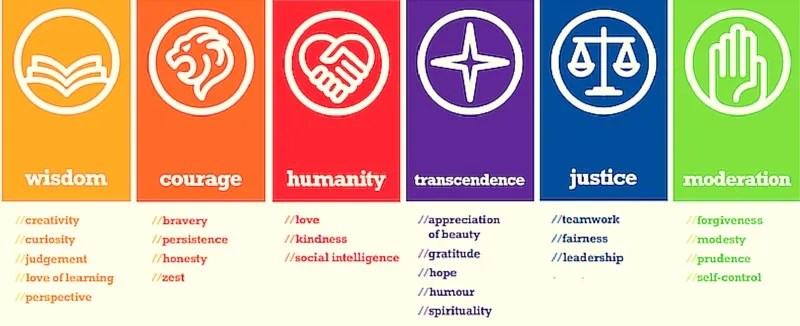
Martin Seligman, American psychologist, author, educator and founder of positive psychology, and fellow researchers in the field studied major religions and philosophical traditions and identified six virtues (see image below) common to cultures across the ages.

(Source: https://positivepsychology.com/classification-character-strengths-virtues/)
Over time (yes, much time—no quick fix here), as we genuinely seek to replace vices with virtues, we slowly become reoriented to new, higher ways of being human. This reorientation then begins to infuse our activism, and overall life, with greater wisdom, justice, courage, humanity, transcendence, and moderation while opening us further to the transformative power of Divine Love, Light, and Life or the Good, the True, and the Beautiful, the three core domains of philosophy and religion.
To be continued.
As we pick up the next leg of our journey to spiritual activism, let us review where we are now. We have our meditation or centering prayer-contemplation practice (ideally, a consistent daily practice of at least 15 minutes/day at a regular time which one slowly, gently builds upon to at least 30 minutes a day not to exceed an hour a day unless one is working with a reputable, advanced spiritual teacher).
We selected and have begun studying our initial map of the territory –a trustworthy, comprehensive psycho-spiritual conceptual framework (see essays 1-3 of this series for some options). We have a spiritual friend and/or a support group with whom we can authentically discuss our efforts and experiences. We also may be journaling and working with a therapist, coach, or spiritual director.
As part of our ongoing healing phase of our journey, we are also practicing self-observation with the intention of “recognizing” when afflictive or negative emotions arise within us, and we are starting to cultivate the capacity to “refrain” from associated hurtful and destructive habituated reactions and patterns.
As we continue these practices (remember this is a life-long spirally journey!), we may notice that we are becoming less reactive, more self-aware, and more able to self-regulate. Thus, we can start to move further into the maturation phase of our three-phase model of the journey to spiritual activism–healing, maturation, and transformation coupled by the increasing arising of and responsiveness to heart-felt inspiration for action that decreases suffering and increases justice, harmony, ecological sustainability, etc. in the world.
Now we are ready to add releasing and replacing to our practice of recognizing and refraining. First, we can release some of the charge of an afflictive emotion or memory with the help of simple techniques such as “pausing” and taking a few deep breaths, or gently putting attention on one’s feet while feeling contact with the floor below. These can be coupled with a silent inner statement of an internal observation, such as “anger arising” which allows for recognition/acceptance of an emotion and restraint while constructively discharging potentially charged energy coupled with an emotion.
According to psychology and neuroscience, it only takes 90 seconds for charged emotional reactions to work their way through our bodies. Thus, if/when a trigger emotion lasts longer than that, we are feeding it with our thoughts and perpetuating the effects on self and others. While recorded over 15 years ago, Dr. Jill Taylor’s TedTalk (and related book, A Stroke of Insight) is as inspiring and relevant now as it was then on this topic.
With some of the energy surge of an afflictive emotion released, we can now replace a negative reactionary habit with a preferred mode of being or ideal. This next phase moves us into the domain of values and ethics which for many people is associated with their faith tradition or spiritual path. Thus, I encourage you to select the values and ethical ideals that most inspire and move your heart to a higher good (e.g., compassion, sustainability, stewardship, justice, etc.) and away from automatic self-centered, negative, hurtful, and destructive modes of being. This replacing phase marks a conscious choice to more mature, responsible, and compassionate speech and actions, and can include a supportive silent prayer, mantra, or saying in the moment such as “love is my decision,” “I have more than enough,” “time is my friend,” the Buddhist Loving Kindness mantra (or metta), or some other anchor word, scripture, mantra or the 12-Step slogans (e.g., “Keep it Simple”).
There are many options for support here to include scripture and literature from one’s chosen or inherited religious tradition or spiritual path. I have benefited from the study of many teachers across the world’s wisdom traditions. Thus, while I have been shaped and inspired by my study and practice of world religions and philosophy, I most resonant with the values taught and lived by Christ Jesus in the Christian Gospels, the Unitarian Universalist Seven Principles, and the Eightfold Path of Buddhism.
In addition, virtue ethics, with roots in Greek philosophy and Christian writings on virtues and vices is and has been highly informative, instructive, and inspirational to me. Most recently, this material includes Brant Pitre’s writings on the topic in his book, Introduction to the Spiritual Life, and Rebecca Konyndyk DeYoung’s book, Glittering Vices.
To be continued
Most leaders, especially those of us interested in contributing to the “Great Transition” desire to be in “right relationship” with our family, friends, loved ones, coworkers, and hopefully, the entire Earth Community. However, many of us may find that as simple as it sounds, it is not always easy to consistently actualize. Furthermore, many of us may find that WE are our biggest obstacles! In other words, unconscious internal barriers may be hurting our relationships and hindering our capacity to fulfill our deepest desires to contribute to a better world.
These internal barriers or scripts are unconscious feeling-sensation-thought-action loops that can be activated by difficult people or circumstances (i.e., triggers). Bodily sensations and emotional responses to “triggers” happen much faster than mental responses or thoughts. In such difficult circumstances, our thoughts tend to lag behind our bodily sensations and emotional responses, and we are in danger of slipping into “automatic pilot” with our thoughts racing to catch up with justifications.
While these habitual patterns differ, there are four common scripts that leaders may recognize:
Self-absorption is an internal pattern with full attention on ME as THE reference point. Thus, my desires, thoughts, feelings, wants, comforts, etc., are all that matter. And, in this state, I will say and do anything that satisfies ME and my wants. I imagine most of us realize (when not stuck in autopilot) how destructive and hurtful this pattern can be in our lives. We can contrast this self-absorption pattern with the more desirable and helpful pattern of seeing oneself as A reference point while also considering the wants and needs of others and our world.
Fault-finding or critical mind is an internal pattern that places full attention on the faults or shortcomings of a person, place, circumstance, or space. Again, I imagine most of us can see the potential for unproductive and destructive outcomes of this script. A constructive alternative to this seductive pattern is the practice of “seeing the good” in a person, circumstance or space. This is similar to the practice of Appreciate Inquiry at group and organizational levels.
Parental and childlike states arise from collective memories or permanent recordings of unprocessed life experiences primarily from one to five years of age. The parental state is often recognizable by absolutes of “should,” “ought,” “must,” “never,” and “always.” While our childlike state is often recognizable by strong feelings of both delight and despair. While there can be positive expressions of these states and styles, Adult: Adult relationships are the aim in many professional environments (for more on this topic, please see my essay, “Using Transactional Analysis for Self-Awareness and Self-Management”).
An ego defense pattern typically arises out of an overidentification with a cherished self-identity associated with a belief, personality, role, or demographic (e.g., race, gender or political affiliation). Indications of being in a state of overidentification include feelings of defensiveness, anger, resentment, self-pity, and self-indignation.
The good news about these unhelpful and potentially hurtful internal patterns is that thanks to the neuroplasticity of our brains, we can reprogram them with constructive alternatives using practices such as the five Rs!
The five Rs to reprogram internal barriers that can hurt relationships and hinder efficacy are–recognizing, refraining, releasing, reorienting, and replacing.
However, as many of us well know (I sure do!), in a difficult moment or exchange, the Five Rs or any other tool for more constructive relating is frequently overtaken by the force of long-standing habitual patterns (i.e., the amygdala response). Thus, for this type of inner development, it is imperative to integrate highly supportive or “transformative” practices into one’s life such as concentration and mindfulness meditation . Over time, these meditation techniques help cultivate the inner witness or observer self. They also help calm the typical human “monkey mind” such that inner mental space starts to grow and offer the practitioner more time to activate the Five Rs and begin dismantling our internal barriers to right-relationship and personal efficacy.
Have you ever read or listened to someone present a theory, conceptual framework, or some other school of thought for the first time and felt completed disoriented by it on the one hand and at the same time experienced an inner pull of “YES! YES!” on the other hand?

Well that is how I felt the first time I encountered the school of thought referred to as evolutionary spirituality or conscious evolution. I believe it was in 1998 when I discovered the work of Pierre Teilhard de Chardin (1881-1955).
Teilhard de Chardin, a pioneer and primary source of evolutionary spirituality overall, was a philosopher, Jesuit priest, paleontologist and geologist whose theological and philosophical work was way ahead of his time such that his ideas were perceived as a threat to the Catholic establishment. Thus, these writings were suppressed during his lifetime.
The core idea of evolutionary spirituality/conscious evolution is that we live in an unfinished universe and its ongoing development toward Universal Love includes us (the human family) and our willingness to actively participate in the evolution of consciousness in/through our lives lived in the world.
In 1998 and now, this work lights me up—it opens my mind and expands my heart! In fact, whenever I’m in a state of despair, I turn to Teilhard’s work but more often contemporary teachers of evolutionary spirituality such as Barbara Marx Hubbard, Michael Dowd, and Brian Swimme. And, most recently to Franciscan friar, spiritual teacher, and author, Richard Rohr’s book, “Universal Christ.”
Thus, as we approach Christmas 2019, I’d like to highlight a few core ideas from Rohr’s book, offer a brief sample of his supportive teachings then share a few of my reflections.
But before I do, I would like to acknowledge that some of you may have instantaneous aversion to the words, “Christ” and “Jesus”– I get it, trust me. I’m a recovering Protestant. And, if that is true for you, I ask that you please set that aside for five minutes and open your mind and heart to the possibility that Rohr might just have a gift for you.
Rohr: …most of the world’s great religions start with some sense of primal goodness in their creation stories. The Judeo-Christian tradition beautifully succeeded at this, with the Genesis record telling us that God called creation “good” five times in Genesis 1, and even “very good” in 1:31. The initial metaphor for creation was a garden, which is inherently positive, beautiful, growth-oriented, a place to be “cultivated and cared for”, where humans could walk naked and without shame. But after Augustine, most Christian theologies shifted from the positive vision of Genesis 1 to the darker vision of Genesis 3—the so-called fall.
I find Rohr’s teaching on Original Goodness not Original Sin a profound and essential one. From about 2008-2015, I immersed myself in Buddhism and seriously considered taking Buddhist vows. However, I chose not to do so for many reasons which I will not go into here, but I am deeply grateful for those seven years and all the benefits that resulted from that period of my life.
One of the many gifts Buddhism gave to me lies in a core teaching on the fundamental goodness of humanity and all life. I did not realize the stranglehold that the teaching of Original Sin had on my being until I truly received and digested the Buddhist teaching on Basic Goodness.
And this is evidently true for many Westerners who turn to Buddhism as Rohr addresses this topic in this book at greater depth in a section entitled, “Why the Interest in Buddhism?”
Rohr: I am convinced that in many ways Buddhism and Christianity shadow each other. They reveal each other’s blind spots. In general, Western Christians have not done contemplation very well, and Buddhism has not done action very well. Although in recent decades we are seeing the emergence of what is called “Engaged Buddhism.”
and I would add the reemergence of “Contemplative Christianity”
Rohr continues this section emphasizing the importance of both contemplation and action on the spiritual journey. I view this marriage of contemplation and action as an evolutionary imperative of our times– deeply related to the transformational shift to a theology and cosmology of a Cosmic or Universal Christ that includes you and me and ALL life.
Rohr: When Christians hear the word “incarnation,” most of us think about the birth of Jesus, who personally demonstrated God’s radical unity with humanity. But in this book, I want to suggest that the first incarnation was the moment described in Genesis 1, when God joined in unity with the physical universe and became the light inside of everything.
The incarnation, then, is not only “God becoming Jesus.” It is a much broader event….Christ that the rest of us continue to encounter in other human beings, a mountain, a blade of grass, or a starling.
When I am graced to see with sacred eyes and orient my being and life from this “everything is holy now” vision, the difference is beyond description. I feel an inner shift from a ho-hum state to a state of aliveness, exuberance and reverence even in the most mundane activities such as walking our dog, Bella.
Thus, as we approach Christmas 2019, the religious holiday commemorating Jesus’s birth, I invite us to consider celebrating our amazing Cosmic Christ. As we do, we may ask ourselves what we, individually and collectively are birthing, in and through the seeds of our thoughts, words, and deeds and then seriously consider how these seeds contribute to a not- yet New Earth of Universal Love.
Peace be unto you. Amen.
Revised 12/24/20
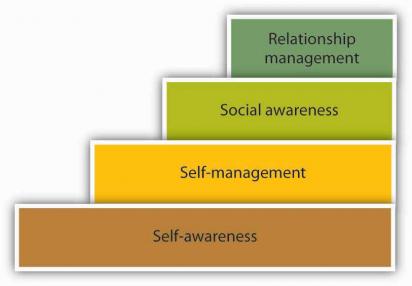
Many students and practitioners of leadership are often on alert for the latest concept, tool, or tip to cultivate greater emotional intelligence (EQ). However, on our search for the latest and greatest, we may be missing out on the nuggets offered by longer standing conceptual frameworks and tools. For example, Transactional Analysis or TA is one such framework that continues to offer leaders support for greater self-awareness, self-management, social awareness, and social management (the four dimensions of EQ).
TA originated in the 1950s by Eric Berne, a Canadian born psychiatrist trained in Freudian psychoanalysis. While this training greatly influenced and informed his work, it did not define it. Unlike Freudian psychoanalysis, TA also focuses on observable communication and behavioral interactions (or transactions) as a means of healing and development. The four basic elements of TA include:
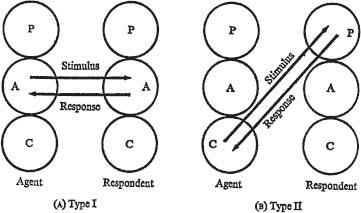
Personally, and professionally, I find the first two elements of TA, the theory of personality and the theory of communication, most helpful as leadership development tools for cultivating greater EQ. The primary reasons for this are the simplicity and accessibility of these two aspects of TA. The TA theory of personality with the Parent-Adult-Child (P-A-C) model proposes that we live in and out of three basic inner states, childlike, adult, or parental. The TA theory of communication postulates that we communicate and behave in accord with our inner state.
With increasing self-awareness (please see my other essays on the importance of meditation and self-observation practices), leaders can recognize (with nonjudgmental acceptance) when they are in a parental or childlike state, refrain from speaking and acting from that state, release the attachment to the patterned reaction, reorient toward the desired adult: adult state and communication style, and replace the habituated (and often destructive or at least unproductive) pattern with a more constructive pattern of relating. Ideally, over time, adult leaders cultivate an increasing capacity for conscious communication.
The parental state and style arise from collective memories or permanent recordings of unprocessed life experiences of interactions with parents and other parental figures, primarily from one to five years of age. One’s basic sense of rules to live by (do’s and don’ts) reside here and cannot be erased (keep reading because our Adult can turn it off!). However, if/when there is disharmony between the parent figures, the impact is greatly reduced. The Parent state and style are often recognizable by absolutes of “should,” “ought,” “must,” “never,” and “always.”
The childlike state and communication style arise from one’s subjective (mainly feelings) childhood experiences primarily from one to five years of age. This state and style are often recognizable by strong feelings of both delight and despair.
The Adult state and style arise from life experiences from 10 months onward that challenge the external parental messages and the internal child feelings with direct lived experiences and thought formations. The Adult gains increasing capacity to recognize the parental tapes and challenge the merit and helpfulness of them while also discerning which feelings are appropriate to express and how to do so.
The Adult is recognizable by the growing capacity to assess the validity or rightness of the information (incoming and Child-Parent tapes) and respond accordingly. While there may be times when a Child or Parent state and style might be a leader’s conscious choice in professional settings, Adult: Adult relationships are the aim.
TA, an oldie but goodie as far as leadership development goes, particularly for cultivating EQ. So, dust off that old copy of “I’m OK, You’re OK” and reread it! You and your colleagues (and loved ones) will be glad you did!
From DISC to Insight Discovery to Meyers Briggs, personality typologies are frequently used as tools for leader development. However, after years of exploring and utilizing such tools, personally and professionally, I’ve come to realize that while they can be extremely helpful, when misused (and sadly, they often are misused), they can stifle development and maturation.
Stunted development and maturation of potential leaders, particularly those who have care and concern for life on earth, are NOT what the world needs now! Therefore, to maximize the developmental utility of personality theories, it is imperative to use them as springboards into the developmental journey and not the destination. In other words, to know one’s personality type or temperament is the beginning and not the destination or aim of the leader development journey. Ideally, the aim of leader development is a fully integrated, mature, and whole human being in service to a better world.
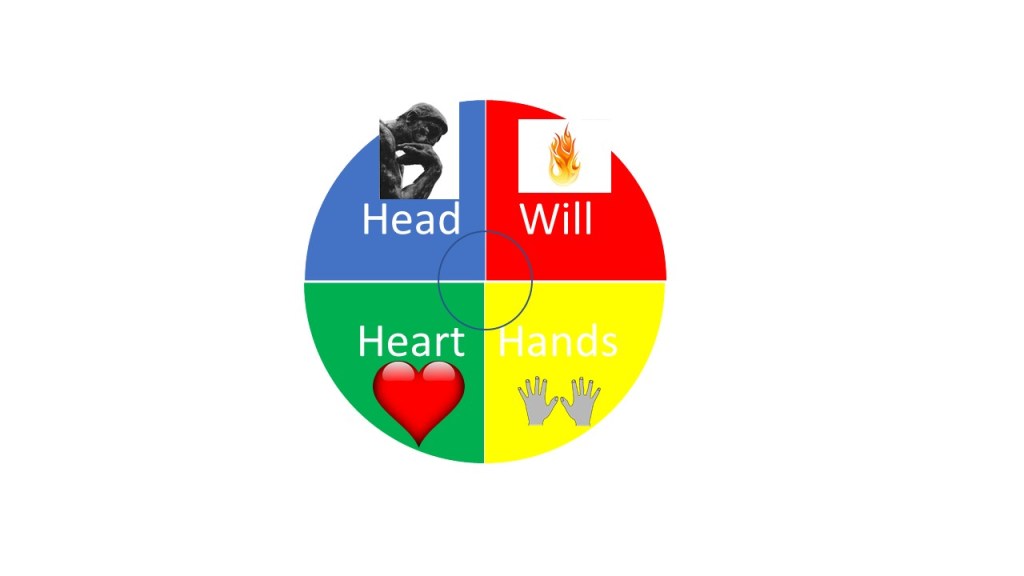
Thus, a more optimal use of temperament or personality models is to inform an integrative leader developmental plan and approach that incorporates and balances the head, heart, hands, and will or the four basic temperaments that form the foundation of many personality typologies (e.g., Insight Discovery—Cool Blue, Earth Green, Sunshine Yellow, and Fiery Red).
There are certainly developmental benefits from using personality typing tools to include the increase of self-awareness (including shadow), and greater self-management. Enhanced self-awareness and self-management are no small feat of course and it’s truly empowering and liberating to grow in these areas! The potential for ongoing growth here continues throughout one’s life. As we discover tendencies toward limiting expressions, we are more able to relax the habitual reactions and consider different perspectives and behavioral responses—truly transformational on the individual, interpersonal, and collective levels!
However, while greater self-awareness and self-management are highly desirable and deeply beneficial, if leaders stop there, they may solidify their identity around their personality type or temperament. This type of solidification of personality can be referred to as overidentification which occurs when we orient our entire identity around a descriptive quality or characteristic such as personality type. Overidentification leads to rigidity, defensiveness, hyper-sensitivity, and hyper-competitiveness as if one’s life were on the line because, in a state of overidentification, it is! Consequently, this internal state significantly limits growth, maturation, and wholeness, because it blocks, refuses, or destroys any impressions that contradict the solidified identity.
To overcome these potential pitfalls, leaders can use their understanding of their personality type to inform an integrative or holistic developmental plan that fosters growth in underdeveloped areas. For example, a will-oriented personality (e.g., Fiery Red in the Insight Discovery typology) can engage in transformative practices that cultivate the heart (e.g. lovingkindness meditation), the head (e.g., reading and studying), and/or the hands (e.g., service and activism).
While leaders can certainly work on one area at a time, approaching leader development from an integrative or holistic approach can greatly accelerate development and propel us toward self-actualization (see Ken Wilber’s or George Leonard’s & Michael Murphy’s work on this topic). Of course, the developmental journey does not end here as there are higher peaks available to those willing to engage in the lifelong dynamic dance of stillness and action while also surrendering to the ultimate mystery of personal transformation, Divine love and grace.

The three systems of self-transformation outlined in my book and recent blog essays offer examples of comprehensive psychospiritual approaches to the inner journey of self-transformation. The transformative practices highlighted throughout my book and essays are elements of these three and other systems of self-transformation. Thus, by themselves and isolated from the system or school of which they are part, transformative practices are limited and potentially harmful for numerous reasons.

Transformative practices isolated from the systems or schools in which they are embedded are limited and potentially harmful because the psychospiritual frameworks in which they are part provide the container for sensemaking and integration of potentially disruptive experiences that may arise from the use of these powerful practices. Remember, the purpose of these practices is inner transformation. Thus, disruption of one’s inner and, most likely, outer life is highly likely and desirable from the perspective of fulfilling this purpose. However, although such disruption is uncomfortable, the degree of discomfort must not exceed the capacities of aspirants to integrate the experiences into life in a way that allows them to function in the world. Thus, unrooted transformative practices have little developmental value and may cause harm.
Additional dangers often referred to as spiritual emergencies, include obsession with mystical experiences rather than disciplined attention to steady incremental inner shifts occurring over time through the difficult and often emotionally painful work of consistent and persistent self-observation and work with transformative practices. This lure is so seductive and persuasive that American psychologist and spiritual teacher, John Welwood coined the term, “spiritual bypassing” to warn contemporary seekers of this potential pitfall.
Furthermore, people may be in danger of ego-inflation and self-aggrandizement arising from exhilarating experiences when using transformative practices. It is critical to note that proper motivation (i.e., desire for development for constructive, preferably virtuous, reasons), humility, and a commitment to ethical living are essential elements of the three systems of self-transformation outlined, as well as the ancient-wisdom traditions highlighted in Chapter 5, and the mindfulness-based interventions and Buddhism discussed in Chapters 1 and 2. In addition, the potential for self-inflation and other forms of self-deception significantly diminish with the assistance of a spiritual friend, coach, director, or community.
The literature on spiritual emergencies also warns of the potential for physical symptoms such as uncontrollable shaking. Accompanying the growing field of transpersonal psychology is increasing awareness and understanding of these types of phenomenon such that more therapists can help clients integrate these experiences in a healthy and productive manner that facilitates growth and does not hinder it. After all, ideally, “spiritual experience is viewed as desirable and spiritual seeking is seen as natural, healthy, and in the final analysis, the only truly fulfilling answer to the challenge of existence” (Cortright, 1997, p. 158) This is certainly the case when the experience builds slowly and incrementally over time, or a sudden powerful experience arises after a solid practice and support foundation is in place to facilitate healthy integration.
Another word of caution is that if you join a psycho-spiritual group associated with any of the three contemporary systems outlined in Chapter 5 or others and the group promotes exclusion or intolerance of people outside the group, leave that group immediately and find one that does not. Exclusion or intolerance toward people outside the group is a flashing warning light of cultish tendencies. All aspirants need to avoid such groups as they are highly inconsistent with the inner journey to self-actualization and Self-realization. Also, if affiliation with a psychospiritual group or community places sexual expectations, excessive financial demands, or attempts to control the personal freedom of its members in any way, quickly move on and out!
Furthermore, while these three systems work with the psychological and spiritual dimensions of the human experience, they emphasize the psychological dimension of the spectrum. Consequently, at some point along the journey, albeit different for everyone, typically after many years of consistent practice, it may become helpful, perhaps necessary, to pick a defined spiritual path (i.e., root oneself in an established religion). I acknowledge that for many 21st-century seekers, perhaps those of us who identify as “spiritual not religious” (an inner struggle of which I am quite familiar) may reject the previous statement. This is quite understandable given the painful failings of our religious institutions over the years. However, I have come to realize that I have no need to throw the baby out with the bathwater, and I invite you to consider this as well.
As highlighted, many, if not all the world’s great religions have inner (esoteric) traditions as well as outer (exoteric) traditions. Most of us are familiar with the exoteric versions of the world religions, which typically emphasize rituals, beliefs, morals, doctrines, and creeds. In contrast, the inner traditions emphasize self-transformation and ultimately the realization of unity with and love of all life and one’s supreme identity and union with God/Spirit/Light. Others may be more at home on an interspiritual or multifaith path which emphasizes the sharing of transformative or union experiences across the religious traditions.
Whether one takes an interspiritual, an esoteric religious, or universal and nonreligious psychospiritual path, it is important to emphasize that they are all maps for the journey of self-transformation; they are not the territory. The territory is one’s life, lived and experienced such that one’s direct experiences of increasing awareness, maturity, and compassion become the barometer of the rightness of one’s chosen path as depicted by the 10 developmental themes of mindful leaders presented in Chapter Four.
However, the purpose of this book is not to provide an overview of the inner traditions of the great religions, which I am not equipped to do; rather I offer a cautionary note as it relates to the inner journey of self-transformation. If the reader would like to explore any or all of the inner traditions mentioned here, I offer a few possible references in the Additional Resources section along with resources for The Fourth Way, Psychosynthesis, Integral Life Practice, and Mindfulness.
I humbly acknowledge that while the inner journey to wholeness takes consistent and persistence “right effort” as emphasized throughout this book, there is a mysterious dimension of the journey that is completely beyond human effort. While there are different names for this mysterious dimension, I will simply call it grace as taught in the Christian tradition. Grace invites surrender, patience, humility, and detachment as it has little to nothing to do with human effort and more to do with God’s/Spirit’s/Light’s infinite love for us and all creation (see Figure).

Note: This essay is an adapted excerpt from my 2018 book, “Ten Developmental Themes of Mindful Leaders.”


 Metamorphosis