
Re-post with correction
Re-post with correction
For this seventh and final essay of this series, I return to the revised definition of spiritual activism I offered in essay two.
Spiritual activism: Intentionally reforming (i.e., challenging to the status quo/business as usual) words and actions for the common good (and/or justice for vulnerable and/or oppressed people, animals, nature, etc.), informed and inspired by a growing understanding (and possibly direct experience) of the ultimate unity of all life coupled with an intensifying inner love for others, life, and the Spirit of Life (i.e., God, Ground of Being, Universal Love, Divine Light, etc.) AND, over time, a deep healing/ liberation/recovery from destructive habitual patterns, in part, by regular, consistent, long-term spiritual practices.
Yes, there is a lot to work with in this definition of spiritual activism. Thus, I invite you to read and reread it aloud, slowly. With that working definition refresh, let us also return to Dante’s Divine Comedy. You may recall that Dante began his journey lost in the dark woods until Virgil arrived and offered him guidance to the Mount of Joy visible in the distance but blocked by three beasts (see essay #5).
With Virgil’s guidance as well as much inner work along the way, Dante makes his way from the dark woods to a bright green, light filled forest, the final level of Purgatory, the Garden of Earthly Paradise where Virgil crowns him the lord of himself (i.e., self-awareness & self-mastery). As Vernon highlights, Dante’s motivation is now pure; his will correctly oriented, and his heart is free to love fully and genuinely. Virgil then bids Dante farewell and departs as reason has taken Dante as far as it can to the border of Paradise (i.e., the transformation/union phase of the spiritual journey). Beatrice (symbol of love) enters the story and becomes his primary guide into Paradise (Note: I am barely scratching the surface of this timeless classical masterpiece. I encourage you to explore it directly yourself along with the assistance of Vernon’s Dante’s Divine Comedy: A Guide for the Spiritual Journey and/or Dante’s Road: The Journey Home for the Modern Soul by Marc Thomas Shaw).
As beautifully illustrated in Dante’s Divine Comedy, the transformative/union phase of the “3-Fold Way” necessitates a letting go of rational understanding; a dropping of preconceived notions and an opening of mind to more unitive ways of knowing while also surrendering to the flow of divine intelligence and energy. From my limited understanding of Taoism, we could also refer to this as wuwei or entering a state of active receptivity. In this state of active receptivity, we open ourselves to the flow of life energy or life force (aka, Holy Spirit, ruach, shakti, chi, etc.) and to the fresh inspirations or movements of the soul that may arise as we surrender our personal agendas.
It is important to note that this is a practice of a lifetime that requires discernment and humility, self-honesty, and openness to feedback themes (Note: If multiple people provide similar feedback, there may be something there to examine). It is also helpful to observe the impact actions have on others—unifying or divisive, helpful or hurtful, constructive or destructive? However, most if not all the systems of self-transformation I have studied and worked with directly emphasize the need for detachment to specific outcomes or results. In other words, assuming good intentions, right effort, and an authentic discernment process, we follow the inspirations and “we let go and let God.” It is critical to reemphasize the necessity for regular self-observation and examination of conscience, in addition to engaging in reality checks with a trusted friend, coach, or spiritual director. Humans have blind spots, shortcomings, and biases. We are all a work in progress! We are going to fail and fall, repeatedly; however, that is the path of healing, maturation, and transformation.
I am going to conclude this series on the topic of spiritual activism with this final essay even though there is much I have not covered adequately. Therefore, if you have not yet chosen a holistic and comprehensive system of self-transformation, please do so before moving on from this essay and series, because as highlighted by Brant Cortright in his book, Psychotherapy and Spirit, “People generally think of the spiritual path as safe-if not easy, then at least a protective haven from the existential insecurity of life, a soothing balm from the inevitable anxieties, fears, and pain of living. But like any great endeavor, the spiritual journey also has its risks and dangers.”
We live in amazing times with the world’s wisdom traditions at our fingertips; however, simply reading these essays or a book or two on spirituality will have little value. The value comes from adopting a way of life that nurtures healing, maturation, wholeness, and transformation over the course of a lifetime. Happy travels fellow sojourner and spiritual activist! Our world needs YOU!
As we continue our journey to spiritual activism, we pick up the fifth essay of this series with where we left off–releasing the charge of an emotional trigger and replacing a habituated destructive reaction (or vice) with a fresh life-affirming response (or virtue). As repeatedly stated, this is much easier to talk about than actualize. Thus, please be compassionate and patient with yourself when you repeatedly fall short. The key point is to continue the full practice (i.e., all core elements of an integrative/holistic/integral life practice (see Essays 1-4 of this series) because over time, with right effort, diligence, and practice, you will feel interior shifts and experience changes in your life and relationships.
It is important to reiterate that while “right effort” is an obvious essential dimension of the inner journey, it is only a part of the sacred mystery of “deep change” along with the paradoxical surrendering of the will (e.g., Step 1 of the Twelve Steps). Coupled with right effort and surrender of self-will is the incomprehensible “Infinite Spirit of Love, Light, and Life” known as Grace in the Christian tradition, freely and generously bestowed upon us as we authentically turn away from destructive ways of being and toward life-affirming ways of being.
Now let us return to Dante’s Divine Comedy (DC) as you may recall that my study of this classical work with the help of guide, Mark Vernon, inspired my decision to embark on this essay series. You may also recall that Dante begins his journey by finding himself lost in the woods:
Midway in our life’s journey, I went astray
from the straight road and woke to find myself
alone in the dark wood.
Shortly after this realization, he lifts his eyes and sees the sun rising which fills him with joy and hope, so he starts toward the mountain he sees in the distance. However, he is suddenly stopped in his tracks by three beasts. While commentaries may differ here, these three beasts are often noted as symbols of the gates of the cardinal vices–lust of life (the lion of wrath, envy, and pride), lust of the eyes (the leopard of greed and worldly sorrow, and lust of the flesh (the wolf of sexual lust, gluttony, and sloth). The three beasts stop Dante in his tracks until his guide, Virgil (a symbol of reason) shows up to support and guide him through Hell then Purgatory as there is no direct ascent up the mountain (the Mount of Joy) and past the three beasts toward the desired destination, the mountain peak of joy (Paradiso).
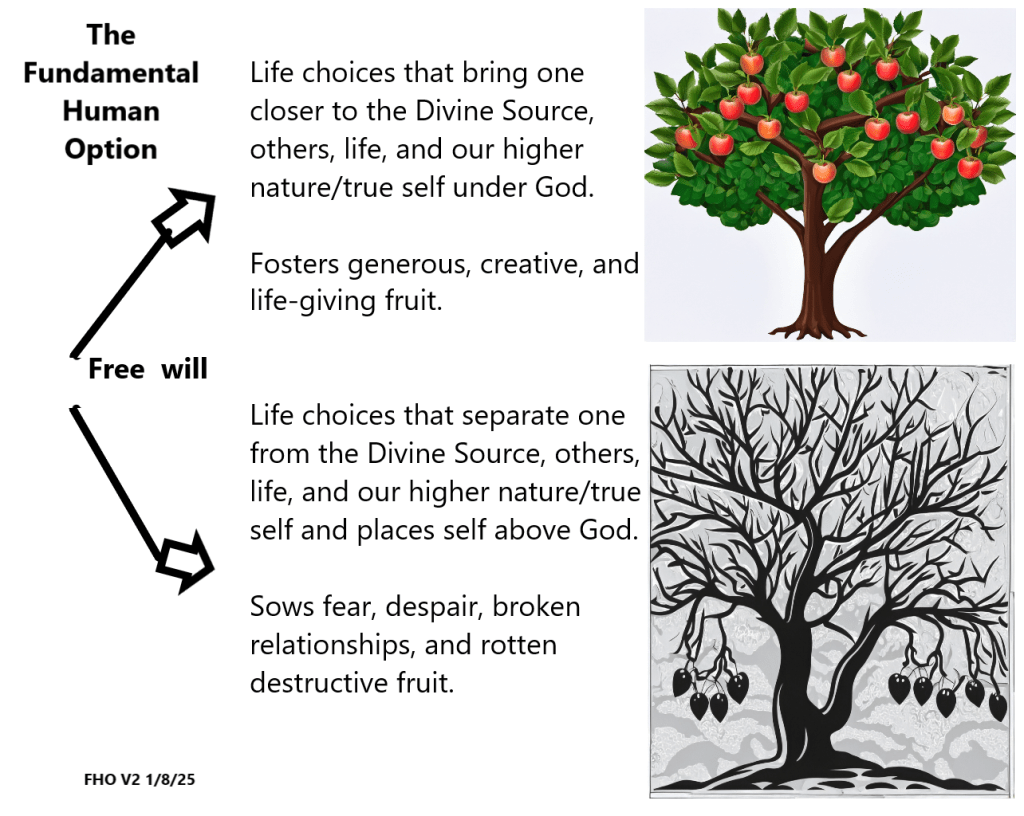
Dante orients his journey and the first two parts of the DC around the Cardinal Vices and Virtues associated with ancient Greek Philosophy and Christianity. While world religions and philosophies differ in beliefs, doctrines, and practices, there are more similarities than differences amongst them in the realm of desirable character traits of followers or ways of relating and living in society (i.e., virtues).
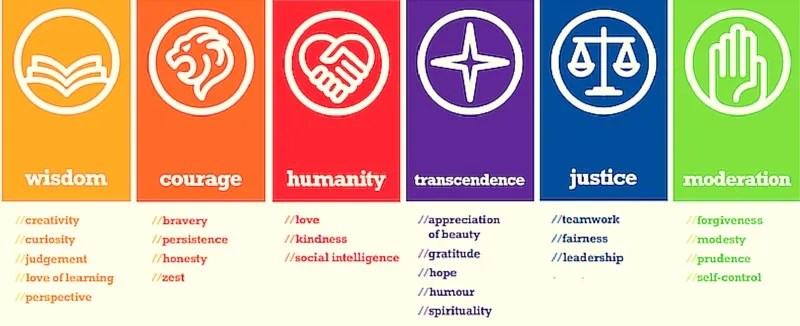
Martin Seligman, American psychologist, author, educator and founder of positive psychology, and fellow researchers in the field studied major religions and philosophical traditions and identified six virtues (see image below) common to cultures across the ages.

(Source: https://positivepsychology.com/classification-character-strengths-virtues/)
Over time (yes, much time—no quick fix here), as we genuinely seek to replace vices with virtues, we slowly become reoriented to new, higher ways of being human. This reorientation then begins to infuse our activism, and overall life, with greater wisdom, justice, courage, humanity, transcendence, and moderation while opening us further to the transformative power of Divine Love, Light, and Life or the Good, the True, and the Beautiful, the three core domains of philosophy and religion.
To be continued.
As we pick up the next leg of our journey to spiritual activism, let us review where we are now. We have our meditation or centering prayer-contemplation practice (ideally, a consistent daily practice of at least 15 minutes/day at a regular time which one slowly, gently builds upon to at least 30 minutes a day not to exceed an hour a day unless one is working with a reputable, advanced spiritual teacher).
We selected and have begun studying our initial map of the territory –a trustworthy, comprehensive psycho-spiritual conceptual framework (see essays 1-3 of this series for some options). We have a spiritual friend and/or a support group with whom we can authentically discuss our efforts and experiences. We also may be journaling and working with a therapist, coach, or spiritual director.
As part of our ongoing healing phase of our journey, we are also practicing self-observation with the intention of “recognizing” when afflictive or negative emotions arise within us, and we are starting to cultivate the capacity to “refrain” from associated hurtful and destructive habituated reactions and patterns.
As we continue these practices (remember this is a life-long spirally journey!), we may notice that we are becoming less reactive, more self-aware, and more able to self-regulate. Thus, we can start to move further into the maturation phase of our three-phase model of the journey to spiritual activism–healing, maturation, and transformation coupled by the increasing arising of and responsiveness to heart-felt inspiration for action that decreases suffering and increases justice, harmony, ecological sustainability, etc. in the world.
Now we are ready to add releasing and replacing to our practice of recognizing and refraining. First, we can release some of the charge of an afflictive emotion or memory with the help of simple techniques such as “pausing” and taking a few deep breaths, or gently putting attention on one’s feet while feeling contact with the floor below. These can be coupled with a silent inner statement of an internal observation, such as “anger arising” which allows for recognition/acceptance of an emotion and restraint while constructively discharging potentially charged energy coupled with an emotion.
According to psychology and neuroscience, it only takes 90 seconds for charged emotional reactions to work their way through our bodies. Thus, if/when a trigger emotion lasts longer than that, we are feeding it with our thoughts and perpetuating the effects on self and others. While recorded over 15 years ago, Dr. Jill Taylor’s TedTalk (and related book, A Stroke of Insight) is as inspiring and relevant now as it was then on this topic.
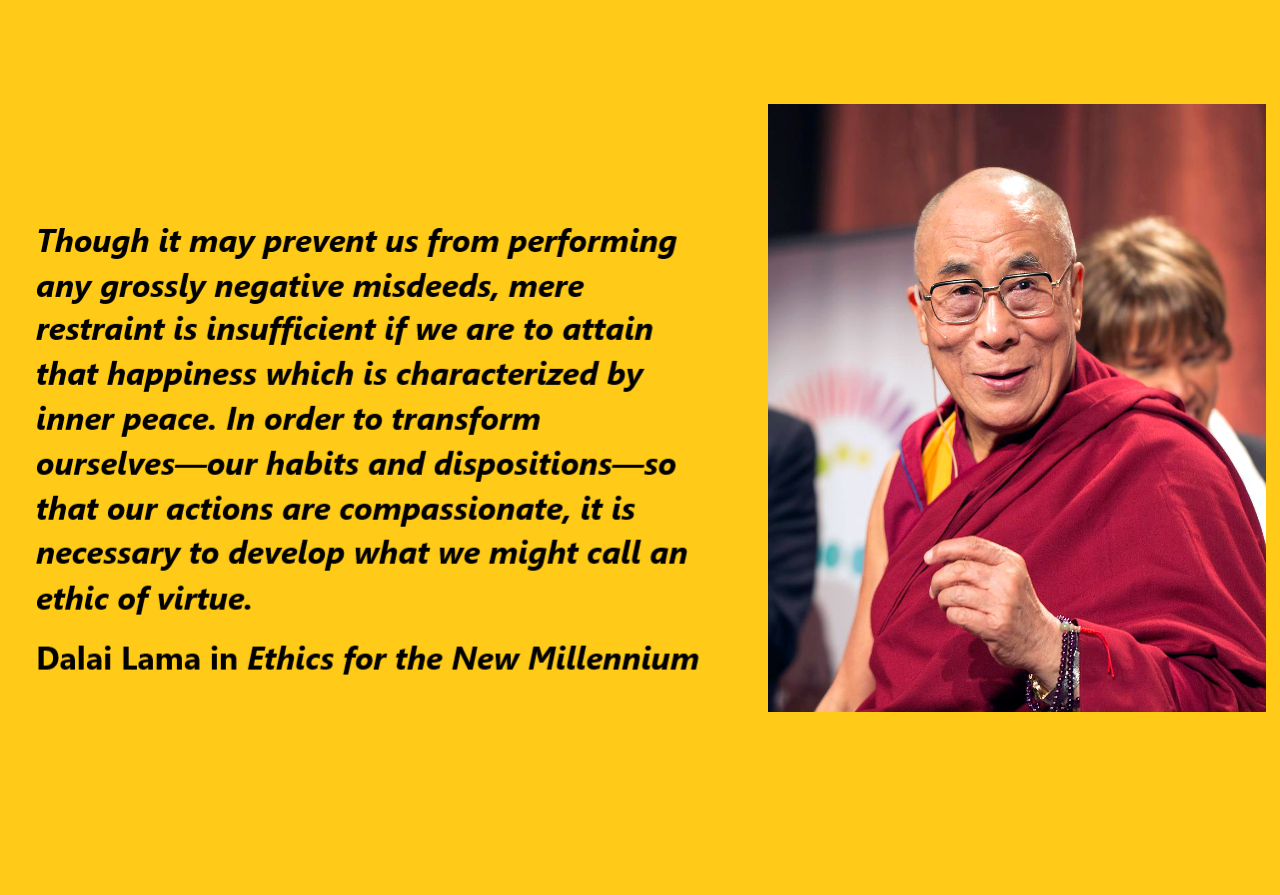
With some of the energy surge of an afflictive emotion released, we can now replace a negative reactionary habit with a preferred mode of being or ideal. This next phase moves us into the domain of values and ethics which for many people is associated with their faith tradition or spiritual path. Thus, I encourage you to select the values and ethical ideals that most inspire and move your heart to a higher good (e.g., compassion, sustainability, stewardship, justice, etc.) and away from automatic self-centered, negative, hurtful, and destructive modes of being. This replacing phase marks a conscious choice to more mature, responsible, and compassionate speech and actions, and can include a supportive silent prayer, mantra, or saying in the moment such as “love is my decision,” “I have more than enough,” “time is my friend,” the Buddhist Loving Kindness mantra (or metta), or some other anchor word, scripture, mantra or the 12-Step slogans (e.g., “Keep it Simple”).
There are many options for support here to include scripture and literature from one’s chosen or inherited religious tradition or spiritual path. I have benefited from the study of many teachers across the world’s wisdom traditions. Thus, while I have been shaped and inspired by my study and practice of world religions and philosophy, I most resonant with the values taught and lived by Christ Jesus in the Christian Gospels, the Unitarian Universalist Seven Principles, and the Eightfold Path of Buddhism.
In addition, virtue ethics, with roots in Greek philosophy and Christian writings on virtues and vices is and has been highly informative, instructive, and inspirational to me. Most recently, this material includes Brant Pitre’s writings on the topic in his book, Introduction to the Spiritual Life, and Rebecca Konyndyk DeYoung’s book, Glittering Vices.
To be continued
For this second essay on the topic of spiritual activism, I would first like to refine my working definition of the concept to the following:
Intentionally reforming (i.e., challenging to the status quo/business as usual) words and actions for the common good, informed and inspired by a growing understanding (and possibly direct experience) of the ultimate unity of all life coupled with an intensifying love for others, life, and the Source (i.e., God, Ground of Being, Universal Love, Divine Light etc.) AND, over time, a deep healing/ liberation/recovery from destructive habitual patterns, in part, by regular, consistent, long-term spiritual practices.
After posting the first essay on this topic, I realized that my initial definition did not explicitly capture the deep healing component of the spiritual journey that I intended. This latest definition attempts to do so with, “AND, over time…”
While different terms are used in the inner traditions of our world religions as well as paths of personal transformation not directly associated with a specific religion (e.g., The Fourth Way), spiritual healing or awakening from spiritual sleep requires the choice to turn inward to begin self-observation with an open, compassionate, honest orientation to increase self-awareness or self-knowledge.

The beginning of awakening from spiritual sleep is to first acknowledge that one is asleep, and that there is a painful degree of discontent present or perhaps, an element of unmanageability to our life (many of us avoid this work until reaching this point). We admit to ourselves and the God of our understanding, “no, I truly do not, got this.” Through regular self-observation, we begin to notice our habitual patterns and character defects (Twelve Steps), negativities (the Fourth Way), or shadow (Carl Jung). As difficult as it is to explain, we begin the spiritual healing or liberation process as soon as we start to see these aspects of ourselves, because they reveal a distinct observing self from the destructive act or mode of being.
As stated in essay one of this series, the material that I share in these essays on spiritual activism is not original. It comes from the systems of personal transformation, those associated directly with religions and some that are not, that I have studied over 20+ years. However, I may not always be able to remember which tradition or what teacher I may have received a teaching from, but I will strive to make those connections for readers. Of note, the world’s religious traditions all have inner spiritual traditions (i.e., paths to spiritual healing, maturation, transformation, and union) as well as more visible and known outer expressions or exoteric traditions with which we are more familiar.
While some spiritual paths such as the Twelve Steps integrate prayer and meditation later in the healing process, my study of and experiences with Buddhism, Contemplative Christianity, and other systems of self-transformation (e.g., the Fourth Way) inform my encouragement to consider a meditation practice, coupled with other self-observation practices, at the beginning (and throughout) of the spiritual journey process unless one has experienced severe trauma and has not yet engaged in any type of therapy or has only recently begun therapy. I am not suggesting an either/or here as I have benefited from both in my journey (i.e., traditional counseling and spiritual healing teachings and practices), but sharing my understanding of sequencing especially if/when one experienced significant trauma and has not yet engaged in any traditional counseling work.
Meditation or simply moments of silence and solitude are essential for the spiritual journey, because they support the cultivation of mental space in which greater clarity and objectivity can arise. Starting and maintaining a regular (at least five times a week if not daily) meditation or silence practice, will provide the essential foundation for the journey to spiritual activism as we begin to slow down enough to become to see ourselves and to start gaining self-awareness. Initially, this growing self-awareness can be extremely difficult. For example, when I started meditating over 15 years ago, I was shocked by the busyness of my mind, the speediness of being, and the anger underlying my activism and much of my life. This was not pleasant, but it was liberating, because I was able to start seeing and facing my habitual patterns and self-destructive and hurtful ways, which provided the needed opening for deep change work to begin.
Such internal seeing and recognizing opens the door to deep change by shedding light on the option to interrupt the automatic or habitual reaction by refraining and replacing, both simple to say but not easy to do as we all know from personal efforts to break unhealthful habits.
To be continued.

When I first created the working title for this essay in parallel with a mini course on the topic, the subtitle I used was “Transforming Ourselves, Transforming our World.” However, when asked to shorten the description for the announcement, I returned it with the subtitle, “Healing Ourselves…” Once I discovered my “error” I quickly made a note to send an email to correct it. However, upon reflection, I realized that “healing” was a more fitting term for this initial essay on spiritual activism, because as I have learned from study of various models of the spiritual journey and my life experience, this journey, a life-long endeavor, typically begins with some phase of inner healing.
For the last eight months, I have been studying Dante’s Divine Comedy. Thanks to a brilliant teacher and guide, Mark Vernon, author of the book, “Dante’s Divine Comedy: A Guide for the Spiritual Journey,” the treasure of Dante’s masterpiece has become accessible to me for the first time (I highly encourage you to check out Vernon’s book and/or his YouTube Channel). In the Divine Comedy, Dante used the classical Christian “3-Fold Way” of purgation (Inferno), illumination (Purgatorio), and union(Paradiso) to illuminate the spiritual journey.
For this essay series on the topic of spiritual activism, I will use the modern terms healing, maturation, and transformation in place of these traditional terms. In addition, I would like to emphasize that this 3-Fold Way stage model of the spiritual journey is one of multiple models that attempt to provide a conceptual framework for spiritual life. In addition, as cautioned by various spiritual teachers I have read (e.g., Thomas Keating, Richard Rohr), these stages are not neatly linear but more interwoven and “spirally” like a strand of DNA and make up an ineffable adventure of a lifetime. In addition, it is also important to note that if one engages the body, mind, and emotions along with intentional practices (e.g., self-observation, meditation, prayer, fasting, etc.) to heal, mature, and transform spiritually, the process can be deepened and accelerated (see Ken Wilber’s Integral Theory writings or my blog essays on Wilber’s work).
Interestingly, I recently heard a teaching by American psychologist, mystic, author, and former monk, James Finley stating that we humans like to jump to transformation and the mystical and avoid healing and the ordinary because the latter are painful, but we cannot. He further added that we need to understand that God is in the healing and ordinary as much as the transformative and mystical.
Reflection on these topics and the need to prepare for the mini-course I agreed to offer on this topic, inspired me to commit to creating a series of essays on being and becoming a spiritual activist. These two decisions were heavily influenced by over 20 years of activism and my longtime study of religious and non-religious systems of self-transformation to include but not limited to Contemplative Christianity, Buddhism, the 12-Steps, Integral Theory (Ken Wilber), and the Fourth Way.
Before I move into discussing the healing stage of the spiritual journey, I would like to offer my working definition of the concept of spiritual activism. By spiritual activism, I am referring to intentional reforming words and actions for greater harmony, justice, or the common good, inspired by a growing understanding (and possibly direct experience) of the ultimate unity or oneness of all life coupled with an intensifying love for others, life, and the Source (i.e., God, Ground of Being, Allah, Divine Light, Eternal Love, etc.) fostered and deepened, in part, by regular spiritual practices. I will return to the topic of spiritual practices and disciplines in a future essay.
So, where to begin the healing phase of this spiritual journey? As American Buddhist nun, Pema Chodron, teaches, “you start where you are” which for most of us is in a state that spiritual teachers often call “lostness” or simply being “asleep.” Of course, we usually do not know we are spiritually asleep until something happens (e.g., COVID, a divorce, employment loss, a terminal diagnosis, a death of a loved one, etc.), and our world falls apart or our life reaches a point of unmanageability due to an addiction to drugs, alcohol, sex, gambling, etc. While these are extremely difficult life circumstances, these periods can propel us into a spiritual awakening by shaking and shattering our world (internal and external) to allow the light of a new perspective in and to ignite a spark of hope for a new way of living.
To be continued.
Most leaders, especially those of us interested in contributing to the “Great Transition” desire to be in “right relationship” with our family, friends, loved ones, coworkers, and hopefully, the entire Earth Community. However, many of us may find that as simple as it sounds, it is not always easy to consistently actualize. Furthermore, many of us may find that WE are our biggest obstacles! In other words, unconscious internal barriers may be hurting our relationships and hindering our capacity to fulfill our deepest desires to contribute to a better world.
These internal barriers or scripts are unconscious feeling-sensation-thought-action loops that can be activated by difficult people or circumstances (i.e., triggers). Bodily sensations and emotional responses to “triggers” happen much faster than mental responses or thoughts. In such difficult circumstances, our thoughts tend to lag behind our bodily sensations and emotional responses, and we are in danger of slipping into “automatic pilot” with our thoughts racing to catch up with justifications.
While these habitual patterns differ, there are four common scripts that leaders may recognize:
Self-absorption is an internal pattern with full attention on ME as THE reference point. Thus, my desires, thoughts, feelings, wants, comforts, etc., are all that matter. And, in this state, I will say and do anything that satisfies ME and my wants. I imagine most of us realize (when not stuck in autopilot) how destructive and hurtful this pattern can be in our lives. We can contrast this self-absorption pattern with the more desirable and helpful pattern of seeing oneself as A reference point while also considering the wants and needs of others and our world.
Fault-finding or critical mind is an internal pattern that places full attention on the faults or shortcomings of a person, place, circumstance, or space. Again, I imagine most of us can see the potential for unproductive and destructive outcomes of this script. A constructive alternative to this seductive pattern is the practice of “seeing the good” in a person, circumstance or space. This is similar to the practice of Appreciate Inquiry at group and organizational levels.
Parental and childlike states arise from collective memories or permanent recordings of unprocessed life experiences primarily from one to five years of age. The parental state is often recognizable by absolutes of “should,” “ought,” “must,” “never,” and “always.” While our childlike state is often recognizable by strong feelings of both delight and despair. While there can be positive expressions of these states and styles, Adult: Adult relationships are the aim in many professional environments (for more on this topic, please see my essay, “Using Transactional Analysis for Self-Awareness and Self-Management”).
An ego defense pattern typically arises out of an overidentification with a cherished self-identity associated with a belief, personality, role, or demographic (e.g., race, gender or political affiliation). Indications of being in a state of overidentification include feelings of defensiveness, anger, resentment, self-pity, and self-indignation.
The good news about these unhelpful and potentially hurtful internal patterns is that thanks to the neuroplasticity of our brains, we can reprogram them with constructive alternatives using practices such as the five Rs!
The five Rs to reprogram internal barriers that can hurt relationships and hinder efficacy are–recognizing, refraining, releasing, reorienting, and replacing.
However, as many of us well know (I sure do!), in a difficult moment or exchange, the Five Rs or any other tool for more constructive relating is frequently overtaken by the force of long-standing habitual patterns (i.e., the amygdala response). Thus, for this type of inner development, it is imperative to integrate highly supportive or “transformative” practices into one’s life such as concentration and mindfulness meditation . Over time, these meditation techniques help cultivate the inner witness or observer self. They also help calm the typical human “monkey mind” such that inner mental space starts to grow and offer the practitioner more time to activate the Five Rs and begin dismantling our internal barriers to right-relationship and personal efficacy.
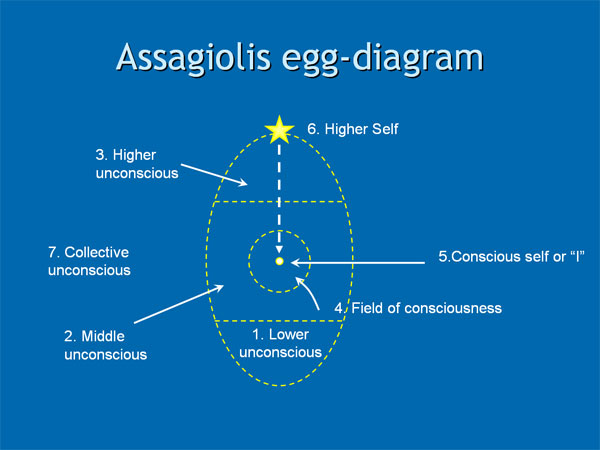
Psychosynthesis is a holistic approach to psychology, developed by Roberto Assagioli (1888-1974) that incorporates psychoanalysis, but significant transcends it by emphasizing health, development, and spirituality. Assagioli illustrated his view of the human psyche in his “egg-diagram” (see Figure) with seven elements:
Figure. Assagioli’s Egg Diagram
Source: Kenneth Sorensen, https://kennethsorensen.dk/en/. Used with permission.
1. The Lower Unconscious
The lower unconscious, according to Assagioli, contains the basic psychological activities that conduct the operative and intelligent coordination of the body and bodily functions. This dimension of the psyche also holds one’s foundational drives and animalistic urges, as well as emotionally intense established thematic patterns (i.e., psychological complexes), dark dreams and fantasies, and some pathological disturbances such as paranoid delusions, uncontrollable urges, obsessions, and phobias.
2. The Middle Unconscious
The middle unconscious, according to Assagioli, includes psychological dimensions comparable to waking consciousness with ready access to it. Life experiences are integrated, and standard cognitive and creative intelligence activated in a type of psychological incubation before entering the field of conscious awareness.
3. The Higher Unconscious or Superconscious
The higher unconscious or superconscious is the region that holds our highest inspirations, aspirations, and intuitions for ourselves, humanity, and our world. This realm is also the source of our higher emotions such unconditional love and higher intelligences. It also holds the deeper experiences of insight, contemplation, and bliss, as well as potentials for higher spiritual experiences and psychic abilities.
4. The Field of Consciousness
For Assagioli, the field of consciousness, a term he thought useful but not quite precise, referred to the part of our personality of which we are conscious, including the thoughts, bodily sensations, emotions, desires, and impulses we are able to see and evaluate.
5. The Conscious Self or “I”
The conscious self or “I” is the term Assagioli used to refer to the “the point of pure-awareness,” not to be confused with the field of consciousness highlighted above, which refers to the content of experience. The conscious self or “I” refers to the experiencer. He compared the “I” to a projector light and field of consciousness to a screen onto which images are projected.
6. The Higher Self
Unlike Freud’s psychoanalysis, which only includes a lower unconscious, Assagioli’s psychosynthesis includes the Higher Self or soul depicted above the conscious self in the egg diagram. According to Assagioli, one can experience the Higher Self through the use of psycho-spiritual practices such as meditation.
7. The Collective Unconscious
Assagioli’s collective unconscious, similar to Jung’s conceptualization of the term, refers to universal, nonpersonal common forms or archetypes that surround and influence us on a collective level. Assagioli distinguished between primitive, archaic forms and higher, progressive forces of a more spiritual nature.
Although not depicted in Assagioli’s original egg diagram (though some contemporary illustrations do include it), another key element of psychosynthesis is the concept of subpersonalities. Subpersonalities, similar to Jung’s persona, refers to parts or formed habit patterns in the human psyche, conscious and unconscious, that we repeatedly express in our lives. For the healthy person, subpersonalities are conscious and in the field of self-awareness and self-regulation. In psychosynthesis, subpersonalities may reside in the lower, middle, or higher unconscious, unlike Jung’s persona or false self. Additional fundamental concepts of psychosynthesis, which highlight stages of Self-realization, include self-knowledge, self-control, disidentification, unifying center, and psychosynthesis, as the peak stage in his model.
Disidentification refers to the necessity of separating oneself (the conscious I) from overidentification with everything outside or beyond oneself. Overidentification can happen any time we identify with an aspect of our life experiences such as a subpersonality, our ethnicity, fear, anxiety, or a role to such an extent that it dominates our lives. Thus, healing and growth opportunities lie in seeing when and where one overidentifies and, with the help of exercises and practices, severing the control of the overidentification on oneself or “I.”
Over time, former objects of overidentification can be healthily integrated into the middle unconscious and accessed more intentionally. The unifying center refers to the discovery or creation of an ideal around which one can reach or reorganize one’s life. Psychosynthesis, in addition to referring to Assagioli’s entire approach to psychotherapy, refers to the peak of the developmental process that establishes a new personality around a primary unifying center: one that is “coherent, organized and unified” (2000, p. 23).
Consequently, personal will (the Will) is a highly significant concept in psychosynthesis such that Assagioli dedicated a book on the topic entitled, The Act of Will. The will is an element of Assagioli’s Star Diagram of Six Psychological Functions (see Figure 5-2/Not included in this essay), which he developed later in his life to complement the egg diagram of the psyche. Lamenting the state of psychology in 1958, Assagioli is quoted as stating, “After losing its soul, psychology lost its will, and only then its mind and senses” (2007, Foreword).
Furthermore, Assagioli held the view of the existence of a transpersonal will, which he viewed as a dormant potentiality for most people. Assagioli’s transpersonal will aligns with what Maslow referred to as “higher needs” and the growing field of transpersonal psychology refers to using a variety of terms that include Christ consciousness, unitive consciousness, peak experiences, mystical experiences, spirit, oneness, and other such similar concepts.
As mentioned above, psychosynthesis proposes a dynamic five-stage healing and realization process (see Table—Not included in this essay). Stage zero highlights the predominate stage of humanity, characterized by what Assagioli called, the “fundamental infirmity of man.” John Firman (?–2008) referred to this human condition as “primal wounding”; wounding resulting from not being seen and heard for who we truly are by significant others in our lives. Stage 1 relates to the tuning in of one’s inner experience and the cultivation of greater self-awareness. Self-awareness is the foundation of all growth and development. Without self-awareness, we tend to react out of instinct and habitual responses or what Firman referred to as, the survival personality. As self-awareness expands, we start to see our tendencies, preferences, and shortcomings.
Eventually, we (often with the help of supportive practices or a skilled guide) begin to free ourselves or disidentify from our habitual thoughts, feelings, reactions, and roles, thereby cultivating the witness or individual observer “I” (Stage 2). Over time, we may start sensing a more expansive identity or connectedness to life and begin to feel new vocational urges, creative impulses, or directive promptings (Stage 3). From a psychosynthesis perspective, this involves surrendering and inviting a more intimate, conscious relationship with the Highest Self or soul. The fourth stage of psychosynthesis corresponds to a period in which we are formally responding to the invitations of the Highest Self (in contrast to the personal self or ego in its contemporary usage) and developing more spiritually.
Survival of wounding, exploration of the personality, the emergence of I, contact with the Highest Self, and response to the Highest Self represent the five stages of psychosynthesis. However, Assagioli and others (e.g., Firman & Gila, 2002 and Brown, 2009) cautioned that these stages do not represent a set developmental sequence, but potential responses to the human condition that can occur at any age.
It is important to note that Assagioli presented psychosynthesis in two subcategories: personal psychosynthesis and transpersonal psychosynthesis. The emphases of personal psychosynthesis are self-awareness and self-regulation. The foci of transpersonal psychosynthesis are on the realization of one’s Highest Self/soul and the actual psychosynthesis, the reformation of the personality around a new unifying center or ideal.
Numerous practices and exercises align with psychosynthesis overall and in these two categories. Thus, to identify a narrow set of core practices is inconsistent with this reality. However, it is fair to say that visualization, drawing, self-observation, and meditation are common practices among psychosynthesis-oriented counselors, therapists, and coaches. In addition, as highlighted above, disidentification is a core concept of psychosynthesis and activities aimed at freeing oneself from overidentifying with a dimension of our being or life other than the center of pure awareness or “I.”
Given today’s pressing global challenges and the subsequent demands on human beings, psychosynthesis offers a holistic and hope-filled paradigm for the journey toward healing, well-being, self-actualization, and Self-realization.
Note: Modified excerpt from my book, “Ten Developmental Themes of Mindful Leaders”





 Metamorphosis