Spiritual Activism: Receiving and Responding to Inspirations of Divine Energy (last essay of series)

For this seventh and final essay of this series, I return to the revised definition of spiritual activism I offered in essay two.

Spiritual activism: Intentionally reforming (i.e., challenging to the status quo/business as usual) words and actions for the common good (and/or justice for vulnerable and/or oppressed people, animals, nature, etc.), informed and inspired by a growing understanding (and possibly direct experience) of the ultimate unity of all life coupled with an intensifying inner love for others, life, and the Spirit of Life (i.e., God, Ground of Being, Universal Love, Divine Light, etc.) AND, over time, a deep healing/ liberation/recovery from destructive habitual patterns, in part, by regular, consistent, long-term spiritual practices.

Yes, there is a lot to work with in this definition of spiritual activism. Thus, I invite you to read and reread it aloud, slowly. With that working definition refresh, let us also return to Dante’s Divine Comedy. You may recall that Dante began his journey lost in the dark woods until Virgil arrived and offered him guidance to the Mount of Joy visible in the distance but blocked by three beasts (see essay #5).

With Virgil’s guidance as well as much inner work along the way, Dante makes his way from the dark woods to a bright green, light filled forest, the final level of Purgatory, the Garden of Earthly Paradise where Virgil crowns him the lord of himself (i.e., self-awareness & self-mastery). As Vernon highlights, Dante’s motivation is now pure; his will correctly oriented, and his heart is free to love fully and genuinely. Virgil then bids Dante farewell and departs as reason has taken Dante as far as it can to the border of Paradise (i.e., the transformation/union phase of the spiritual journey). Beatrice (symbol of love) enters the story and becomes his primary guide into Paradise (Note: I am barely scratching the surface of this timeless classical masterpiece. I encourage you to explore it directly yourself along with the assistance of Vernon’s Dante’s Divine Comedy: A Guide for the Spiritual Journey and/or Dante’s Road: The Journey Home for the Modern Soul by Marc Thomas Shaw).

As beautifully illustrated in Dante’s Divine Comedy, the transformative/union phase of the “3-Fold Way” necessitates a letting go of rational understanding; a dropping of preconceived notions and an opening of mind to more unitive ways of knowing while also surrendering to the flow of divine intelligence and energy. From my limited understanding of Taoism, we could also refer to this as wuwei or entering a state of active receptivity. In this state of active receptivity, we open ourselves to the flow of life energy or life force (aka, Holy Spirit, ruach, shakti, chi, etc.) and to the fresh inspirations or movements of the soul that may arise as we surrender our personal agendas.

It is important to note that this is a practice of a lifetime that requires discernment and humility, self-honesty, and openness to feedback themes (Note: If multiple people provide similar feedback, there may be something there to examine). It is also helpful to observe the impact actions have on others—unifying or divisive, helpful or hurtful, constructive or destructive? However, most if not all the systems of self-transformation I have studied and worked with directly emphasize the need for detachment to specific outcomes or results. In other words, assuming good intentions, right effort, and an authentic discernment process, we follow the inspirations and “we let go and let God.” It is critical to reemphasize the necessity for regular self-observation and examination of conscience, in addition to engaging in reality checks with a trusted friend, coach, or spiritual director. Humans have blind spots, shortcomings, and biases. We are all a work in progress! We are going to fail and fall, repeatedly; however, that is the path of healing, maturation, and transformation.

I am going to conclude this series on the topic of spiritual activism with this final essay even though there is much I have not covered adequately. Therefore, if you have not yet chosen a holistic and comprehensive system of self-transformation, please do so before moving on from this essay and series, because as highlighted by Brant Cortright in his book, Psychotherapy and Spirit,  “People generally think of the spiritual path as safe-if not easy, then at least a protective haven from the existential insecurity of life, a soothing balm from the inevitable anxieties, fears, and pain of living. But like any great endeavor, the spiritual journey also has its risks and dangers.”

We live in amazing times with the world’s wisdom traditions at our fingertips; however, simply reading these essays or a book or two on spirituality will have little value. The value comes from adopting a way of life that nurtures healing, maturation, wholeness, and transformation over the course of a lifetime. Happy travels fellow sojourner and spiritual activist! Our world needs YOU!
Spiritual Activism: Reorienting to the Good, the True, and the Beautiful (Essay 6 of Series)

As we continue our journey deeper into spiritual activism, we pick up the sixth essay of this series with where we left off—replacing vices with virtues and the process of reorienting one’s being to the good, the true, and the beautiful. As I currently understand it, the good, true, and the beautiful are the common philosophical categories representing the highest expression of being within the three dimensions of the human psyche or soul—the will, the mind, and the emotions and thus in turn, in and through life lived, individually and collectively.

Individual ideals or virtues can be ordered within one of these three primary categories. Thus, as we work to reorient our being and lives in the direction of our ideals, choice by choice, day by day, it is essential to maintain honest awareness of where we are in the present (Note: Most of us need a spiritual director, friend, and/or community to help us as we can easily deceive ourselves here). All the progress made in the initial phases of our healing and maturing work provides a solid foundation of self-awareness which continues to reveal our character flaws, strengths, emotional wounds and vulnerabilities, gifts, and habitual patterns more clearly and allows us to compassionately examine how they influence and shape our lives and our happiness (Friendly reminder: This is a not a linear process but a life-long, iterative, ripening of being).

Our growing self-awareness sheds light on which of “the three beasts” (i.e., the symbols used in Dante’s DC to represent the gates of the cardinal vices highlighted in Essay 5) is the most predominant inner obstacle to our reorientation of beingness. As we start to “connect the dots” of our inner world, we can select spiritual practices most suited for facilitating ongoing deep change (i.e., reorientation).

For example, in the spiritual literature, fasting is often encouraged as an essential core practice for “lust of the flesh” (sexual lust, gluttony, and sloth); tithing and charitable giving to include money, possessions, and volunteer service for “lust of the eyes” (greed and worldly sorrow), and prayer and meditation or contemplation for “lust of life” (wrath, envy, and spiritual pride). 

It is important to reemphasize that across the world religions prayer and meditation or contemplation are essential core practices for all of us seeking to heal, mature, and transform in service to a higher common good (see chart below). There are many excellent resources, spiritual and religious, available to help inform and guide one’s selection of spiritual practices to include Richard Foster’s classic Christian guidebook, “Celebration of Discipline” and those cited in my book, Ten Developmental Themes of Mindful Leaders, Table 5.1.

Wisdom TraditionExamples of Transformative Practices Associated with Wisdom Traditions of the West
Christianity-InnerLectio Divina (sacred reading)Centering Prayer (meditation)ContemplationPrayerService
Islam-SufismChantingPrayerBreathing ExercisesMusic & Dancing/WhirlingMeditation
Judaism-KabbalahStudy of the Torah, Talmud, the Zohar and other sacred textsMeditationPrayerPilgrimages to Holy PlacesShabbat/Sabbath

Table Source: Frizzell, Denise (2018). Ten Developmental Themes of Mindful Leaders.

As stated previously, initially, and potentially for a significant period, reorienting to the good, the true, and the beautiful may feel like an inner battle. However, each time we reject a habituated destructive choice (a vice) for a desired good (a virtue or ideal), we are strengthened in our efforts by a budding inner aliveness, sense of freedom, and happiness, as well as improving interpersonal relationships, and growing life satisfaction. Over time,  we experience a growing ease or disposition for the good, true, and beautiful coupled by a simultaneous increasing distaste for our old harmful habits.

Furthermore, as we reorient more into our new, higher selves, we may notice an increasing sense of unity with other people, nature, and overall LIFE as well as an expanding love for self (not as in the selfishness of our old, false self but as in a growing dignity and self-respect), for other people, nature, and God/Spirit/Divine Source, which readies us for entering into the transforming phase of our journey to spiritual activism –receiving and responding to the movements of inspiration for the well-being of others and the common good.

To be continued.

Spiritual Activism: Replacing Vices with Virtues and Growing Up (Essay 5 of Series)

As we continue our journey to spiritual activism, we pick up the fifth essay of this series with where we left off–releasing the charge of an emotional trigger and replacing a habituated destructive reaction (or vice) with a fresh life-affirming response (or virtue). As repeatedly stated, this is much easier to talk about than actualize. Thus, please be compassionate and patient with yourself when you repeatedly fall short. The key point is to continue the full practice (i.e., all core elements of an integrative/holistic/integral life practice (see Essays 1-4 of this series) because over time, with right effort, diligence, and practice, you will feel interior shifts and experience changes in your life and relationships.

It is important to reiterate that while “right effort” is an obvious essential dimension of the inner journey, it is only a part of the sacred mystery of “deep change” along with the paradoxical surrendering of the will (e.g., Step 1 of the Twelve Steps). Coupled with right effort and surrender of self-will is the incomprehensible “Infinite Spirit of Love, Light, and Life” known as Grace in the Christian tradition, freely and generously bestowed upon us as we authentically turn away from destructive ways of being and toward life-affirming ways of being.

Now let us return to Dante’s Divine Comedy (DC) as you may recall that my study of this classical work with the help of guide, Mark Vernon, inspired my decision to embark on this essay series. You may also recall that Dante begins his journey by finding himself lost in the woods:

Midway in our life’s journey, I went astray

from the straight road and woke to find myself

alone in the dark wood.

Shortly after this realization, he lifts his eyes and sees the sun rising which fills him with joy and hope, so he starts toward the mountain he sees in the distance. However, he is suddenly stopped in his tracks by three beasts. While commentaries may differ here, these three beasts are often noted as symbols of the gates of the cardinal vices–lust of life (the lion of wrath, envy, and pride), lust of the eyes (the leopard of greed and worldly sorrow, and lust of the flesh (the wolf of sexual lust, gluttony, and sloth). The three beasts stop Dante in his tracks until his guide, Virgil (a symbol of reason) shows up to support and guide him through Hell then Purgatory as there is no direct ascent up the mountain (the Mount of Joy) and past the three beasts toward the desired destination, the mountain peak of joy (Paradiso).  

Dante orients his journey and the first two parts of the DC around the Cardinal Vices and Virtues associated with ancient Greek Philosophy and Christianity. While world religions and philosophies differ in beliefs, doctrines, and practices, there are more similarities than differences amongst them in the realm of desirable character traits of followers or ways of relating and living in society (i.e., virtues).

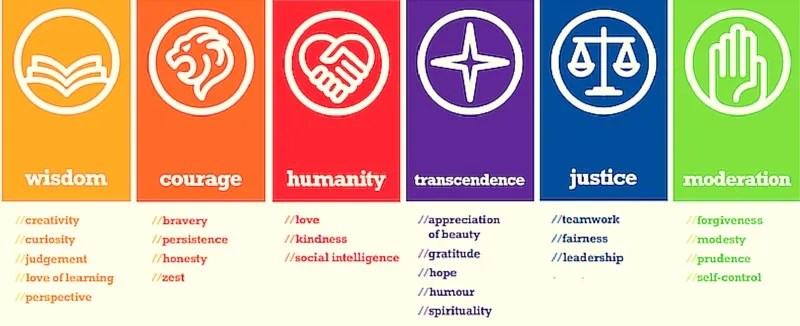
Martin Seligman, American psychologist, author, educator and founder of positive psychology, and fellow researchers in the field studied major religions and philosophical traditions and identified six virtues (see image below) common to cultures across the ages.

(Source: https://positivepsychology.com/classification-character-strengths-virtues/)

Over time (yes, much time—no quick fix here), as we genuinely seek to replace vices with virtues, we slowly become reoriented to new, higher ways of being human. This reorientation then begins to infuse our activism, and overall life, with greater wisdom, justice, courage, humanity, transcendence, and moderation while opening us further to the transformative power of Divine Love, Light, and Life or the Good, the True, and the Beautiful, the three core domains of philosophy and religion.

To be continued.