
If some chubby, fuzzy worms eventually fly, what goodness might be waiting to be born within you?

If some chubby, fuzzy worms eventually fly, what goodness might be waiting to be born within you?

For this seventh and final essay of this series, I return to the revised definition of spiritual activism I offered in essay two.
Spiritual activism: Intentionally reforming (i.e., challenging to the status quo/business as usual) words and actions for the common good (and/or justice for vulnerable and/or oppressed people, animals, nature, etc.), informed and inspired by a growing understanding (and possibly direct experience) of the ultimate unity of all life coupled with an intensifying inner love for others, life, and the Spirit of Life (i.e., God, Ground of Being, Universal Love, Divine Light, etc.) AND, over time, a deep healing/ liberation/recovery from destructive habitual patterns, in part, by regular, consistent, long-term spiritual practices.
Yes, there is a lot to work with in this definition of spiritual activism. Thus, I invite you to read and reread it aloud, slowly. With that working definition refresh, let us also return to Dante’s Divine Comedy. You may recall that Dante began his journey lost in the dark woods until Virgil arrived and offered him guidance to the Mount of Joy visible in the distance but blocked by three beasts (see essay #5).
With Virgil’s guidance as well as much inner work along the way, Dante makes his way from the dark woods to a bright green, light filled forest, the final level of Purgatory, the Garden of Earthly Paradise where Virgil crowns him the lord of himself (i.e., self-awareness & self-mastery). As Vernon highlights, Dante’s motivation is now pure; his will correctly oriented, and his heart is free to love fully and genuinely. Virgil then bids Dante farewell and departs as reason has taken Dante as far as it can to the border of Paradise (i.e., the transformation/union phase of the spiritual journey). Beatrice (symbol of love) enters the story and becomes his primary guide into Paradise (Note: I am barely scratching the surface of this timeless classical masterpiece. I encourage you to explore it directly yourself along with the assistance of Vernon’s Dante’s Divine Comedy: A Guide for the Spiritual Journey and/or Dante’s Road: The Journey Home for the Modern Soul by Marc Thomas Shaw).
As beautifully illustrated in Dante’s Divine Comedy, the transformative/union phase of the “3-Fold Way” necessitates a letting go of rational understanding; a dropping of preconceived notions and an opening of mind to more unitive ways of knowing while also surrendering to the flow of divine intelligence and energy. From my limited understanding of Taoism, we could also refer to this as wuwei or entering a state of active receptivity. In this state of active receptivity, we open ourselves to the flow of life energy or life force (aka, Holy Spirit, ruach, shakti, chi, etc.) and to the fresh inspirations or movements of the soul that may arise as we surrender our personal agendas.
It is important to note that this is a practice of a lifetime that requires discernment and humility, self-honesty, and openness to feedback themes (Note: If multiple people provide similar feedback, there may be something there to examine). It is also helpful to observe the impact actions have on others—unifying or divisive, helpful or hurtful, constructive or destructive? However, most if not all the systems of self-transformation I have studied and worked with directly emphasize the need for detachment to specific outcomes or results. In other words, assuming good intentions, right effort, and an authentic discernment process, we follow the inspirations and “we let go and let God.” It is critical to reemphasize the necessity for regular self-observation and examination of conscience, in addition to engaging in reality checks with a trusted friend, coach, or spiritual director. Humans have blind spots, shortcomings, and biases. We are all a work in progress! We are going to fail and fall, repeatedly; however, that is the path of healing, maturation, and transformation.
I am going to conclude this series on the topic of spiritual activism with this final essay even though there is much I have not covered adequately. Therefore, if you have not yet chosen a holistic and comprehensive system of self-transformation, please do so before moving on from this essay and series, because as highlighted by Brant Cortright in his book, Psychotherapy and Spirit, “People generally think of the spiritual path as safe-if not easy, then at least a protective haven from the existential insecurity of life, a soothing balm from the inevitable anxieties, fears, and pain of living. But like any great endeavor, the spiritual journey also has its risks and dangers.”
We live in amazing times with the world’s wisdom traditions at our fingertips; however, simply reading these essays or a book or two on spirituality will have little value. The value comes from adopting a way of life that nurtures healing, maturation, wholeness, and transformation over the course of a lifetime. Happy travels fellow sojourner and spiritual activist! Our world needs YOU!
As we continue our journey to spiritual activism, we pick up the fifth essay of this series with where we left off–releasing the charge of an emotional trigger and replacing a habituated destructive reaction (or vice) with a fresh life-affirming response (or virtue). As repeatedly stated, this is much easier to talk about than actualize. Thus, please be compassionate and patient with yourself when you repeatedly fall short. The key point is to continue the full practice (i.e., all core elements of an integrative/holistic/integral life practice (see Essays 1-4 of this series) because over time, with right effort, diligence, and practice, you will feel interior shifts and experience changes in your life and relationships.
It is important to reiterate that while “right effort” is an obvious essential dimension of the inner journey, it is only a part of the sacred mystery of “deep change” along with the paradoxical surrendering of the will (e.g., Step 1 of the Twelve Steps). Coupled with right effort and surrender of self-will is the incomprehensible “Infinite Spirit of Love, Light, and Life” known as Grace in the Christian tradition, freely and generously bestowed upon us as we authentically turn away from destructive ways of being and toward life-affirming ways of being.
Now let us return to Dante’s Divine Comedy (DC) as you may recall that my study of this classical work with the help of guide, Mark Vernon, inspired my decision to embark on this essay series. You may also recall that Dante begins his journey by finding himself lost in the woods:
Midway in our life’s journey, I went astray
from the straight road and woke to find myself
alone in the dark wood.
Shortly after this realization, he lifts his eyes and sees the sun rising which fills him with joy and hope, so he starts toward the mountain he sees in the distance. However, he is suddenly stopped in his tracks by three beasts. While commentaries may differ here, these three beasts are often noted as symbols of the gates of the cardinal vices–lust of life (the lion of wrath, envy, and pride), lust of the eyes (the leopard of greed and worldly sorrow, and lust of the flesh (the wolf of sexual lust, gluttony, and sloth). The three beasts stop Dante in his tracks until his guide, Virgil (a symbol of reason) shows up to support and guide him through Hell then Purgatory as there is no direct ascent up the mountain (the Mount of Joy) and past the three beasts toward the desired destination, the mountain peak of joy (Paradiso).
Dante orients his journey and the first two parts of the DC around the Cardinal Vices and Virtues associated with ancient Greek Philosophy and Christianity. While world religions and philosophies differ in beliefs, doctrines, and practices, there are more similarities than differences amongst them in the realm of desirable character traits of followers or ways of relating and living in society (i.e., virtues).
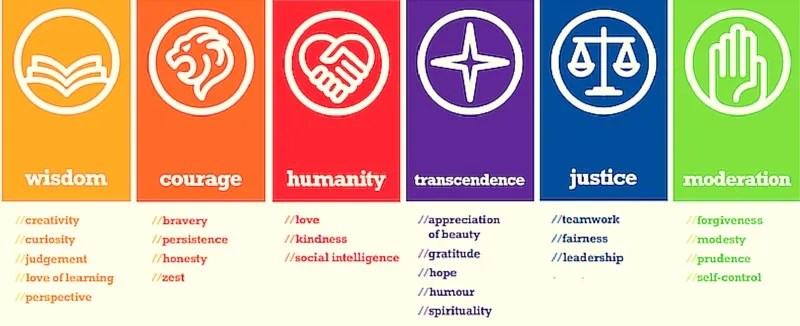
Martin Seligman, American psychologist, author, educator and founder of positive psychology, and fellow researchers in the field studied major religions and philosophical traditions and identified six virtues (see image below) common to cultures across the ages.

(Source: https://positivepsychology.com/classification-character-strengths-virtues/)
Over time (yes, much time—no quick fix here), as we genuinely seek to replace vices with virtues, we slowly become reoriented to new, higher ways of being human. This reorientation then begins to infuse our activism, and overall life, with greater wisdom, justice, courage, humanity, transcendence, and moderation while opening us further to the transformative power of Divine Love, Light, and Life or the Good, the True, and the Beautiful, the three core domains of philosophy and religion.
To be continued.
Before I pick up where I left off in the second essay of this series, I would like to give expression to a relevant teaching that I was reminded of while reading the book, “Matthew Fox: Essential Writings on Creation Spirituality” by Charles Burack. The teaching highlights the necessity of affirming the “original blessing” (from Aquinas’ “original goodness”) of human life as central to beginning the spiritual journey to wholeness and holiness.
Reading this work on Fox’s writings reminded me of my initial encounter with his teachings on “original blessing” (versus original sin) that I encountered in the 90’s while reading his book, “Creation Spirituality” on the urging of a friend who was then a student of his Oakland, CA based school, University of Creation Spirituality. At the time, while an exciting revolutionary concept to me, it did not land on “fertile soil.” Thankfully, my 7-year deep study and practice of Buddhism from 2010-2017, particularly Shambhala Buddhism and the writings of Pema Chodron and Chogyan Trungpa Rimpoche (1939-1987) provided the necessary compost to reawaken and revitalize the dormant mental seed planted which blossomed into a flower of liberation during a Buddhist meditation retreat weekend early in this period.

For readers with traditional Christian backgrounds (and thus most likely the “original sin” malaise), (re)awakening to this truth is especially important before starting this type of deep healing work, and I was remiss in not including that statement earlier. (For more on the concept of “original blessing” I encourage you to read one of the many books authored by American priest and theologian, Matthew Fox.
If we return to Dante’s “Divine Comedy,” the source of the inspiration for embarking on this adventure to author this essay series on the topic of spiritual activism, we can see this necessity present in Dante’s journey. Initially, Dante informs his guide, Virgil, that he is not strong enough for the first leg of the journey—hell. However, after Virgil explains that he is there to assist him, because Beatrice asked him to do so out of her concern and love for him, Dante musters the courage to follow Virgil through the Gate of Hell. This revelation of Beatrice’s love and his lovability (i.e., original goodness) fuels his courage to face his fears.
Now, picking up where I left off. As stated in the second essay of this series on spiritual activism, internal seeing and recognition of habituated destructive life patterns– the inner capacities cultivated, over time, by regular self-observation practices along with daily meditation and prayer– are the beginnings of freedom from them.
If/when one is serious about making deep personal change, these difficult and painful realizations source the motivation to attempt the challenging act of refraining from a habituated reaction. Notice the word, “attempt” here. Refraining from habituated reactions takes effort and practice. One may not do so in the first few attempts. One may fall short a lot; however, over time one develops the capacity to notice the habituated pattern arise in one’s being sooner and sooner and sooner such that one day the person will be able to catch “the train” right as it starts to depart the station. At that point, they will be able to refrain and replace or reorient to the desired ideal, mode, or way of being.
Usually one uncovers past hurts, woundedness, untruths, shadow elements, and outmoded thinking underneath habituated patterns during this healing phase of the journey, which as highlighted previously is continuous and spiral-like versus linear. Again, not pleasant, but liberating. Stay with it but expect an internal fight.
An internal fight is to be expected as one’s small self, ego, or operational self is challenged by this work. There is an aspect of the psyche that is threatened by this inner work of healing, maturing, and transforming to being and becoming a spiritual activist (aka, a “transformed nonconformist” MLK Jr). Thus, it is essential that you find support for your journey to include a comprehensive framework to inform, guide, and provide insight into the complex internal process underway.
Personally, I have benefited from several such frameworks to include Integral Life Practice (Ken Wilber and Terry Patten), Psychosynthesis (Roberto Assagioli), the Fourth Way (especially the writings of Ted & Rebecca Nottingham), as well as Contemplative Christianity (Thomas Keating, Richard Rohr, Cynthia Bourgeault), and as mentioned previously, Buddhism, especially the work of American Buddhist nun, Pema Chodron whose writings I highly recommend for this phase of the journey especially, “No Time to Lose: A Timely Guide to the Way of the Bodhisattva or the section of this book presented in her work, “Don’t Bite the Hook.”)
Of note, I briefly cover these frameworks and traditions as well as cautions for the spiritual journey in my book, “Ten Developmental Themes of Mindful Leaders. The book version is available on my website as a free PDF download and an audio version available via Audible. I have also authored essays on some of them which are available on my website as well.
In addition to adopting and studying at least one of these schools, traditions, or frameworks, you may want to journal, and work with a therapist and/or reputable support group especially during the initial phase of this work. Minimally, I encourage you to have at least one trusted support person you can authentically discuss your experience with who will objectively listen without offering unsolicited advice.
To be continued.
Have you ever read or listened to someone present a theory, conceptual framework, or some other school of thought for the first time and felt completed disoriented by it on the one hand and at the same time experienced an inner pull of “YES! YES!” on the other hand?

Well that is how I felt the first time I encountered the school of thought referred to as evolutionary spirituality or conscious evolution. I believe it was in 1998 when I discovered the work of Pierre Teilhard de Chardin (1881-1955).
Teilhard de Chardin, a pioneer and primary source of evolutionary spirituality overall, was a philosopher, Jesuit priest, paleontologist and geologist whose theological and philosophical work was way ahead of his time such that his ideas were perceived as a threat to the Catholic establishment. Thus, these writings were suppressed during his lifetime.
The core idea of evolutionary spirituality/conscious evolution is that we live in an unfinished universe and its ongoing development toward Universal Love includes us (the human family) and our willingness to actively participate in the evolution of consciousness in/through our lives lived in the world.
In 1998 and now, this work lights me up—it opens my mind and expands my heart! In fact, whenever I’m in a state of despair, I turn to Teilhard’s work but more often contemporary teachers of evolutionary spirituality such as Barbara Marx Hubbard, Michael Dowd, and Brian Swimme. And, most recently to Franciscan friar, spiritual teacher, and author, Richard Rohr’s book, “Universal Christ.”
Thus, as we approach Christmas 2019, I’d like to highlight a few core ideas from Rohr’s book, offer a brief sample of his supportive teachings then share a few of my reflections.
But before I do, I would like to acknowledge that some of you may have instantaneous aversion to the words, “Christ” and “Jesus”– I get it, trust me. I’m a recovering Protestant. And, if that is true for you, I ask that you please set that aside for five minutes and open your mind and heart to the possibility that Rohr might just have a gift for you.
Rohr: …most of the world’s great religions start with some sense of primal goodness in their creation stories. The Judeo-Christian tradition beautifully succeeded at this, with the Genesis record telling us that God called creation “good” five times in Genesis 1, and even “very good” in 1:31. The initial metaphor for creation was a garden, which is inherently positive, beautiful, growth-oriented, a place to be “cultivated and cared for”, where humans could walk naked and without shame. But after Augustine, most Christian theologies shifted from the positive vision of Genesis 1 to the darker vision of Genesis 3—the so-called fall.
I find Rohr’s teaching on Original Goodness not Original Sin a profound and essential one. From about 2008-2015, I immersed myself in Buddhism and seriously considered taking Buddhist vows. However, I chose not to do so for many reasons which I will not go into here, but I am deeply grateful for those seven years and all the benefits that resulted from that period of my life.
One of the many gifts Buddhism gave to me lies in a core teaching on the fundamental goodness of humanity and all life. I did not realize the stranglehold that the teaching of Original Sin had on my being until I truly received and digested the Buddhist teaching on Basic Goodness.
And this is evidently true for many Westerners who turn to Buddhism as Rohr addresses this topic in this book at greater depth in a section entitled, “Why the Interest in Buddhism?”
Rohr: I am convinced that in many ways Buddhism and Christianity shadow each other. They reveal each other’s blind spots. In general, Western Christians have not done contemplation very well, and Buddhism has not done action very well. Although in recent decades we are seeing the emergence of what is called “Engaged Buddhism.”
and I would add the reemergence of “Contemplative Christianity”
Rohr continues this section emphasizing the importance of both contemplation and action on the spiritual journey. I view this marriage of contemplation and action as an evolutionary imperative of our times– deeply related to the transformational shift to a theology and cosmology of a Cosmic or Universal Christ that includes you and me and ALL life.
Rohr: When Christians hear the word “incarnation,” most of us think about the birth of Jesus, who personally demonstrated God’s radical unity with humanity. But in this book, I want to suggest that the first incarnation was the moment described in Genesis 1, when God joined in unity with the physical universe and became the light inside of everything.
The incarnation, then, is not only “God becoming Jesus.” It is a much broader event….Christ that the rest of us continue to encounter in other human beings, a mountain, a blade of grass, or a starling.
When I am graced to see with sacred eyes and orient my being and life from this “everything is holy now” vision, the difference is beyond description. I feel an inner shift from a ho-hum state to a state of aliveness, exuberance and reverence even in the most mundane activities such as walking our dog, Bella.
Thus, as we approach Christmas 2019, the religious holiday commemorating Jesus’s birth, I invite us to consider celebrating our amazing Cosmic Christ. As we do, we may ask ourselves what we, individually and collectively are birthing, in and through the seeds of our thoughts, words, and deeds and then seriously consider how these seeds contribute to a not- yet New Earth of Universal Love.
Peace be unto you. Amen.
Revised 12/24/20


As the rate of change continues to increase exponentially and our lives become more interdependent, complex, and uncertain, humanity needs holistic or integrative frameworks to better understand and respond to the unprecedented demands of the 21st century. These unparalleled demands include threats to our very survival as a species from pressures of climate change, terrorism, water scarcity, food insecurity, poverty and social inequality, political corruption, and economic instability.
Consequently, U.S. philosopher Ken Wilber proposed that any truly integrative or integral view of human and social phenomenon must minimally include the individual subjective/interior, the individual behavioral/exterior, the collective intersubjective/interior, and the collective interobjective/exterior. Borrowing from Wilber’s All Quadrant All Level or AQAL framework, an integrative approach to leader development addresses the individual internal and individual external dimensions while acknowledging the larger context of leadership development and leadership. Thus, in this more expansive context, an integrative leader-development framework must first consider human existence and well-being from a holistic perspective, as well as the insights and learnings from adult-development theory.

Given that leaders are first and foremost human, the foundation of this integrative leader-development framework is a comprehensive view of human existence and well-being or wellness. Wellness is a holistic and proactive view of health that regards humans as beings with physical bodies, mental bodies, emotional bodies, and spiritual bodies embedded in social and natural environments and dependent on a vibrant planet Earth. Wellness also emphasizes the overall quality of life and not solely the absence of disease. Wellness is highly significant to leader development because general wellness supports full and consistent access to current developmental capacities and provides the “fertile ground” necessary for ongoing self-development. Although various models of wellness exist, a general framework includes physical, mental-emotional, financial or material, spiritual, social, and environmental dimensions.
Physical well-being is a core dimension of wellness and generally refers to the capacity to meet the demands and potential crises of ordinary life. When physical health and vitality are compromised, it is more difficult to be one’s best self or tend to other areas of wellness. Physical wellness includes regular exercise or body movement, healthy weight, strength and flexibility, rest and relaxation, and sleep. It also includes one’s food and beverage choices and how they affect one’s overall well-being, including general health, vitality, energy, mood, weight, body-mass index (BMI), and stamina.
Mental-emotional wellness refers to awareness, constructive expression, and healthy integration of thoughts and feelings. Thus, mental-emotional wellness includes numerous areas that are highly relevant to an integrative approach to leader development such as mental attitudes, beliefs, mindsets, thoughts, feelings, personality, shadow, identity, motivation, will, self-awareness, perceptions, and self-regulation. Financial or material wellness refers to having adequate financial or material resources to meet essential basic human needs (e.g., food, potable water, clothing, and shelter) and support the fulfillment of higher needs (e.g., self-actualization).
Spiritual wellness refers to a sense of interconnectedness or relationship to and with all life/Life (immanent and transcendent), as well as a sense of awe and appreciation for the mysteries of life/Life. Furthermore, spiritual (or existential) wellness relates to the meaning and purpose derived from contributing to ideals or causes beyond the self (e.g., justice, peace, and sustainability). Social wellness refers to one’s ability to have and maintain healthy adult relationships in all areas of life (e.g., intimate, family, work, and community). Also, social wellness refers to a sense of belonging in the world as well as the capacity to engage in authentic, skillful, and constructive self-expression and communication. Environmental wellness refers to the overall quality and stability of one’s social and natural environments.
Furthermore, as highlighted in Wilber’s Integral Theory, the physical body can be viewed as three bodies, not one, which is also highly significant in an integrative leader-development framework. The three bodies are the gross body, the subtle body, and the causal body. The gross body or actual physical body includes all aspects of the body we typically think about—our skin, bones, muscles, systems, organs, tissues, cells, blood, etc.
The subtle body includes energies of the life force associated with human existence. Wilber’s AQAL associates the subtle body with dream states where earthly laws disintegrate. However, the energies of the subtle body are not limited to sleeping states. They are activated and alive in times of vision, inspiration, and creativity. Thus, although still not formally recognized by Western physiology, growing appreciation for and acceptance of subtle energies enlivens our being, as found in Eastern healing and religious traditions such as tai chi, yoga, and Hinduism. Furthermore, as other leadership writers have emphasized (e.g., Jim Loehr & Tony Schwartz, 2005 and Bruce Schneider, 2008), leaders who understand the role of subtle body energies will increase their potential for effectiveness, especially in the turbulent times of the 21st century.
The third body, the causal body aligns with deep sleep and an infinite openness, stillness, and formlessness or the Ground of Being. This is the body or state that the great mystics of the ages speak of, as expressed in the poem, “Expands His Being,” by Meister Eckhart (1260–1328):
All beings are words of God,
—In Love Poems from God (Ladinsky, 2002)
His music, His art.
Sacred books we are, for the infinite camps in our souls.
Every act reveals God and expands His Being.
I know that may be hard to comprehend.
All creatures are doing their best
to help God in His birth of Himself.
Enough talk for the night.
He is laboring in me;
I need to be silent for a while,
worlds are forming in my heart.
Thus, the three human bodies—gross, subtle, and causal—are highly relevant to this integrative leader-development framework, as addressed further throughout this book.
Note: This essay is an excerpt from my book, “Ten Developmental Themes of Mindful Leaders” available on Amazon. An audiobook version is also available on Audible, iTunes, and Amazon.
Following a dynamic U.S. mid-term election that continues to unfold, the heart-breaking destruction and death from the worst wildfires the state of California has ever experienced, and the ongoing madness of the US national political scene, I read a news headline that prompted me to ask myself, “how can we free ourselves from the either/or thinking that has us trapped in a downward free fall?”
While an excellent article on the political landscape for Democrats in the upcoming 2020 US Presidential Election, the headline, Midterm elections return Democrats to a debate over their 2020 presidential choice: Passion or pragmatism? (Matt Viser, November 10, 2018), illuminates the either/or thinking trap that limits humanity’s capacity to respond to the challenges of our times creatively.
We, Americans and all peoples, live in a complex and interconnected world. We face unprecedented challenges to our quality of life and the lives of future generations such as climate change, natural resource depletion, political corruption, growing inequality, mass extinction of species, global terrorism and numerous economic challenges, war, and world hunger.
Given the scale of our challenges, it is essential that we all join hands to address our collective problems. Unfortunately, America’s current political climate and tone are divisive and regressive. How can we overcome the toxic and dark forces to effectively respond to our challenges and usher in a positive future? Our religious traditions have called humanity to live in unity throughout the ages. For example:
And, in Taoism, the theme of unity and mutual interrelation of all things and events, represented in the religious symbol itself, is fundamental.
With all this encouragement for unity from our religious traditions, where might we start to begin to unify? The American Heritage Dictionary defines unity as the arrangement of parts into a whole. Thus, to unify as a people and solve our most pressing global problems, we must first unify our thinking.
We cannot solve problems at the same level of thinking that created them. We must learn to see the world anew. Albert Einstein
Unified thinking requires us to move from either/or thinking to both/and thinking. Actualizing this third way of thinking about and responding to the challenges before us – shifting from fragmented parts to an interconnected whole – -is the evolutionary imperative of the 21 Century, which does not mean everything is equal. It is not. Both/and thinking requires discernment of breadth and depth. How inclusive and how deep?
Much has been written about this urgent need to move from either/or to both/and thinking (i.e., from fragmented parts to wholes)- thereby expanding our thinking and creating comprehensive frameworks to guide our lives. A few such authors include Hazel Henderson, Fritjof Capra, Buckminster Fuller, Barbara Marx Hubbard, Duane Elgin, and Ken Wilbur.
Ken Wilbur, one of the most widely read and influential American philosophers of our time, has written over a dozen books, including, A Spectrum of Consciousness; A Brief History of Everything; and Up from Eden. He developed a unified field theory of consciousness, a synthesis, and interpretation of the world’s great psychological, philosophical, and spiritual traditions. Wilbur refers to his approach as Integral which is synonymous with the concept of unified thinking. In his Integral Theory, he identifies four essential quadrants of reality and argues that we must integrate the truths of all four quadrants to solve our most urgent social problems and fulfill our potential. In other words, each quadrant is only a part of the whole. Standing alone, each quadrant is incomplete.
The essential message is that we face unprecedented and complex challenges to our quality of lives and the lives of future generations. We will not and cannot successfully overcome these challenges with the same fragmented thinking that created them. Starting with our own lives, we have a unique opportunity and responsibility to help lead the essential shift from either/or to both/and thinking at every level of society. Three areas that beg for unified thinking are reason and faith; the economy and the natural environment, and the individual and the common good (To be continued).