Integral Life Practice or ILP is a comprehensive and holistic
approach to leader self-transformation rooted in integral theory, developed by
U.S. philosopher and writer, Kenneth Wilber II (born 1949). Wilber born in
Oklahoma City, currently resides in Denver, CO, where he continues to study,
write, and present his work primarily through the Internet and Colorado-based outlets, albeit on
a limited basis due to a severe and chronic illness. He is the author of more
than 30 books and countless articles on consciousness, mysticism, psychology,
science, religion, and his integral theory, a comprehensive synthesis of
Eastern and Western knowledge.
Wilber
refers to his version of integral theory as AQAL, the abbreviated acronym for
all quadrants, all levels (all lines, all states, all types, etc.). The
elements of quadrants and levels refer to the key explanatory principles Wilber
uses to examine the development of individual mind, body, soul, and spirit in
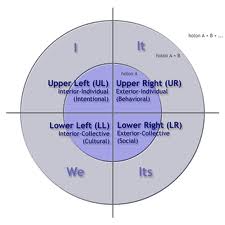
self, culture, community, and nature. The four quadrants include the Upper Left
or individual interior, the Upper Right or individual exterior, the Lower Left or
collective interior, and the Lower Right or collective exterior (see Figure).
Wilber further simplifies the four quadrants with the “three basic domains” of
I, we, and it.
Figure:
Integral Theory and AQAL
ILP, informed by Wilber’s AQAL, is an approach to enhanced
personal wellness, development, self-actualization, and spiritual awakening.
ILP addresses the whole person and all of life through four basic modules of
practice and five auxiliary modules. The four foundational modules are body,
mind, spirit, and shadow. The five auxiliary models are ethics, work, emotions,
relationships, and soul (see Table).
An ILP approach to self-transformation does not include core
practices per se. Rather, the ILP framework invites adherents to select at
least one practice from each of the four core modules and to add practices from
the auxiliary modules, as highlighted in the Table above. The practices listed
in the matrix offer example practices for each module; however, options are not
limited to those listed. Developers of the ILP approach outline five principles
on which it builds:
· The Ultimate in Cross-Training, working synergistically in body, mind, and spirit in self, culture, and nature. · Modular, allowing you to mix and match practices in specific areas or modules. · Scalable, adjusting to however much—or little—time you have, down to 1-Minute Modules. · Customizable to your lifestyle: you design a program that works for you and adapt it on an as-needed basis. · Integral, based on AQAL technology, an All Quadrant, All Level framework for mapping the many capacities inherent in human beings (See Integral Life Practice by Wilber, Patten, Leonard, & Morelli, 2008).
Furthermore, all modules include Gold Star Practices,
recommended as “distillations of traditional practices minus the religious and
cultural baggage” (Wilber, Leonard, & Morelli, 2008). Also, quick versions
of the Gold Star Practices, 1-Minute Modules, are offered for times when
practitioners are pressed for time.
Integral Life Practice along with the Fourth Way, and Psychosynthesis
(see previous essays) represent three different contemporary and universal
systems of self-transformation. Mindfulness meditation, the transformative
practice I focused on in my 2015 research and highlighted in Chapters 3 and 4
(of my book, Ten Developmental Themes of
Mindful Leaders), is part of the Eightfold Path of Buddhism as well as an
element of a growing body of secular Western approaches to stress management
(e.g., Mindfulness Based Stress Reduction), and psychotherapy (e.g.,
Mindfulness Based Cognitive Therapy and Acceptance Commitment Therapy). While a
primary purpose of this essay and my book is to inspire and support readers in
embarking upon the inner journey of self-transformation, doing so is not
without risks. Thus, I offer words of caution in my book and will also do so in
a future blog essay.
The Fourth Way is a term used to refer to a body of teachings and practices with roots in the work of G. I. Gurdjieff (1866?–1949). Gurdjieff, born in Armenia, is a bit of an enigma and controversial figure, but writings about his life consistently report that he studied various schools of religious and philosophical thought as a youth and traveled extensively as a young adult throughout the East (reportedly areas of Central Asia and the Middle East) in search of spiritual truths. He then returned to Russia and began sharing what he had learned and experienced. He developed The Fourth Way as a path of self-development and transformation that integrated singular paths of the body (the fakirs of Sufism), mind (the yogis of Hinduism), and emotions (the monks of Christianity) that he studied and encountered in his travels.
Shortly after he returned to Russia, Gurdjieff met P. D. Ouspensky who became one of his most well-known pupils until they parted ways in 1918. Ouspensky then relocated to England and became a teacher of The Fourth Way in his own right, through lectures and writings. Gurdjieff, whose life was greatly impacted by social upheavals and military conflicts (revolutions and World Wars I & II) traveled and taught in Germany, England, and France throughout the 1920–1940s and visited the United States during that period as well. He had two serious and life-threatening auto accidents during this period but recovered from both. Gurdjieff died in France in 1949.
The Fourth Way teachings are powerful and highly supportive of self-transformation. The Fourth Way posits that the majority of people live in mechanical or sleep states. Consequently, most of humanity resides in lives of quiet desperation, filled with suffering, and destructive habitual patterns of thinking, speaking, and acting. According to The Fourth Way and other systems of self-transformation, this “fundamental infirmity of man” referenced by the founder of Psychosynthesis, Roberto Assagioli (see January 2019 blog essay or TDT), is so because we do not remember who we are and why we are here because of longstanding dysfunctional patterns, particularly overidentification, negativity, and internal considering; blocking self-remembering (or self-awareness).
Overidentification is
a fundamental obstacle to self-remembering and occurs whenever we lose
ourselves to an identity such as a belief, characteristic, demographic (e.g., race,
gender or political affiliation), personality, or role. Overidentification
occurs so unconsciously and quickly that most of us are completely unaware when
(which is most of the time), we are stuck in overidentification. Indications of
being in a state of overidentification include feelings of defensiveness,
anger, resentment, self-pity, and self-indignation. When overidentified, one
can easily feel they are in a constant state of attack, which locks us into a
toxic state of negativity.
Negativity refers to
thoughts, emotions, words, and actions that constrict our minds and hearts and
cause harm to ourselves and others. Negativity is so toxic because it infects
our inner and outer environments and locks us into destructive patterns.
Negativity closely aligns with overidentification and internal considering.
Internal considering refers to a degree of self-absorption and narcissism that
sees life only from the impact events will have on oneself, with little or no
concern for the impact events may have on others or our planet. The
consequences of living in a state of sleep and being trapped in
overidentification, negativity, and internal considering include misery,
suffering, loss of energy and power, a sense of disconnection from oneself,
others, and God/Spirit/Light, and ultimately, violence.
To begin to awaken
from sleep and cultivate self-awareness requires self-observation, the main
transformative practice associated with The Fourth Way. Writings and teachings
of The Fourth Way offer numerous practical exercises to cultivate
self-observation, including an activity frequently referred to as “divided
attention.” Divided attention instructs aspirants to periodically place
attention on their inner experience and outer experience of a select
phenomenon. For example, as a practitioner enters a doorway, he/she would place
attention on an aspect of their internal experience (e.g., thoughts, bodily
sensations, or feelings/emotions) as well as an aspect of the external
experience (as experienced by the five senses). Repeated practice of such
exercises builds one’s capacity for self-awareness such that over time, the
practitioner can eventually use divided attention in more challenging life
circumstances (e.g., an interpersonal conflict) thereby increasing the
likelihood of constructive social interactions and outcomes.
Essential to all
self-observation exercises is an objective and nonjudgmental attitude toward
all noticings or observations. A
nonjudgmental attitude toward one’s observations allows a healthy
disidentification from them as well as an expanding psychological space in
which to choose more constructive states from which thoughts and actions can
arise. Over time, sensitivity to and dislike of negative states and attraction
to positive states act as motivational forces for the ongoing relinquishment of
lower or negative states in favor of more positive states.
Psychosynthesis is a holistic approach to psychology, developed
by Roberto Assagioli (1888-1974) that incorporates psychoanalysis, but
significant transcends it by emphasizing health, development, and spirituality.
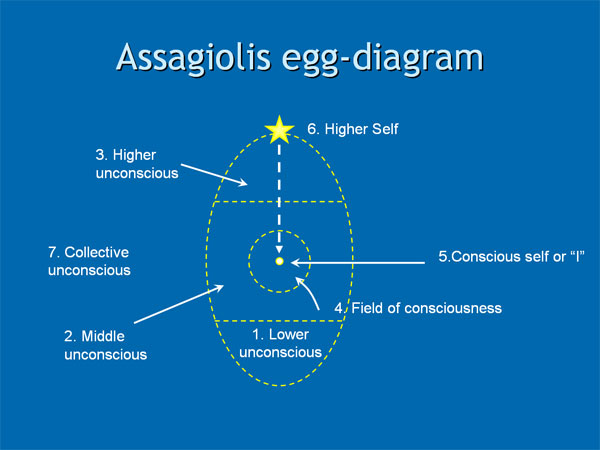
Assagioli illustrated his view of the human psyche in his “egg-diagram” (see
Figure) with seven elements:
The lower unconscious, according to Assagioli, contains the basic
psychological activities that conduct the operative and intelligent
coordination of the body and bodily functions. This dimension of the psyche
also holds one’s foundational drives and animalistic urges, as well as
emotionally intense established thematic patterns (i.e., psychological
complexes), dark dreams and fantasies, and some pathological disturbances such
as paranoid delusions, uncontrollable urges, obsessions, and phobias.
2. The Middle
Unconscious
The middle unconscious, according to Assagioli, includes
psychological dimensions comparable to waking consciousness with ready access
to it. Life experiences are integrated, and standard cognitive and creative
intelligence activated in a type of psychological incubation before entering the
field of conscious awareness.
3. The Higher
Unconscious or Superconscious
The higher unconscious or superconscious is the region that holds
our highest inspirations, aspirations, and intuitions for ourselves, humanity,
and our world. This realm is also the source of our higher emotions such
unconditional love and higher intelligences. It also holds the deeper
experiences of insight, contemplation, and bliss, as well as potentials for
higher spiritual experiences and psychic abilities.
4. The Field of
Consciousness
For Assagioli, the field of consciousness, a term he thought
useful but not quite precise, referred to the part of our personality of which
we are conscious, including the thoughts, bodily sensations, emotions, desires,
and impulses we are able to see and evaluate.
5. The Conscious
Self or “I”
The conscious self or “I” is the term Assagioli used to refer to
the “the point of pure-awareness,” not to be confused with the field of
consciousness highlighted above, which refers to the content of experience. The
conscious self or “I” refers to the experiencer. He compared the “I” to a
projector light and field of consciousness to a screen onto which images are
projected.
6. The Higher Self
Unlike Freud’s psychoanalysis, which only includes a lower
unconscious, Assagioli’s psychosynthesis includes the Higher Self or soul
depicted above the conscious self in the egg diagram. According to Assagioli,
one can experience the Higher Self through the use of psycho-spiritual practices
such as meditation.
7. The Collective
Unconscious
Assagioli’s collective unconscious, similar to Jung’s
conceptualization of the term, refers to universal, nonpersonal common forms or
archetypes that surround and influence us on a collective level. Assagioli
distinguished between primitive, archaic forms and higher, progressive forces
of a more spiritual nature.
Although not depicted in Assagioli’s original egg diagram (though
some contemporary illustrations do include it), another key element of
psychosynthesis is the concept of subpersonalities. Subpersonalities, similar
to Jung’s persona, refers to parts or formed habit patterns in the human
psyche, conscious and unconscious, that we repeatedly express in our lives. For
the healthy person, subpersonalities are conscious and in the field of
self-awareness and self-regulation. In psychosynthesis, subpersonalities may
reside in the lower, middle, or higher unconscious, unlike Jung’s persona or
false self. Additional fundamental concepts of psychosynthesis, which highlight
stages of Self-realization, include self-knowledge, self-control,
disidentification, unifying center, and psychosynthesis, as the peak stage in
his model.
Disidentification refers to the necessity of separating oneself
(the conscious I) from overidentification with everything outside or beyond
oneself. Overidentification can happen any time we identify with an aspect of
our life experiences such as a subpersonality, our ethnicity, fear, anxiety, or
a role to such an extent that it dominates our lives. Thus, healing and growth
opportunities lie in seeing when and where one overidentifies and, with the
help of exercises and practices, severing the control of the overidentification
on oneself or “I.”
Over time, former objects of overidentification can be healthily
integrated into the middle unconscious and accessed more intentionally. The
unifying center refers to the discovery or creation of an ideal around which
one can reach or reorganize one’s life. Psychosynthesis, in addition to
referring to Assagioli’s entire approach to psychotherapy, refers to the peak
of the developmental process that establishes a new personality around a
primary unifying center: one that is “coherent, organized and unified” (2000,
p. 23).
Consequently, personal will (the Will) is a highly significant
concept in psychosynthesis such that Assagioli dedicated a book on the topic
entitled, The Act of Will. The will
is an element of Assagioli’s Star Diagram of Six Psychological Functions (see
Figure 5-2/Not included in this essay), which he developed later in his life to
complement the egg diagram of the psyche. Lamenting the state of psychology in
1958, Assagioli is quoted as stating, “After losing its soul, psychology lost
its will, and only then its mind and senses” (2007, Foreword).
Furthermore, Assagioli held the view of the existence of a
transpersonal will, which he viewed as a dormant potentiality for most people.
Assagioli’s transpersonal will aligns with what Maslow referred to as “higher
needs” and the growing field of transpersonal psychology refers to using a
variety of terms that include Christ consciousness, unitive consciousness, peak
experiences, mystical experiences, spirit, oneness, and other such similar
concepts.
As mentioned above, psychosynthesis proposes a dynamic five-stage
healing and realization process (see Table—Not included in this essay). Stage
zero highlights the predominate stage of humanity, characterized by what
Assagioli called, the “fundamental infirmity of man.” John Firman (?–2008)
referred to this human condition as “primal wounding”; wounding resulting from
not being seen and heard for who we truly are by significant others in our
lives. Stage 1 relates to the tuning in of one’s inner experience and the
cultivation of greater self-awareness. Self-awareness is the foundation of all
growth and development. Without self-awareness, we tend to react out of instinct
and habitual responses or what Firman referred to as, the survival personality. As self-awareness expands, we start to
see our tendencies, preferences, and shortcomings.
Eventually, we (often with the help of supportive practices or a
skilled guide) begin to free ourselves or disidentify
from our habitual thoughts, feelings, reactions, and roles, thereby cultivating
the witness or individual observer “I” (Stage 2). Over time, we may start
sensing a more expansive identity or connectedness to life and begin to feel
new vocational urges, creative impulses, or directive promptings (Stage 3).
From a psychosynthesis perspective, this involves surrendering and inviting a
more intimate, conscious relationship with the Highest Self or soul. The fourth
stage of psychosynthesis corresponds to a period in which we are formally
responding to the invitations of the Highest Self (in contrast to the personal
self or ego in its contemporary usage) and developing more spiritually.
Survival of wounding, exploration of the personality, the
emergence of I, contact with the Highest Self, and response to the Highest Self
represent the five stages of psychosynthesis. However, Assagioli and others
(e.g., Firman & Gila, 2002 and Brown, 2009) cautioned that these stages do
not represent a set developmental sequence, but potential responses to the
human condition that can occur at any age.
It is important to note that Assagioli presented psychosynthesis
in two subcategories: personal psychosynthesis and transpersonal
psychosynthesis. The emphases of personal psychosynthesis are self-awareness
and self-regulation. The foci of transpersonal psychosynthesis are on the
realization of one’s Highest Self/soul and the actual psychosynthesis, the
reformation of the personality around a new unifying center or ideal.
Numerous practices and exercises align with psychosynthesis
overall and in these two categories. Thus, to identify a narrow set of core
practices is inconsistent with this reality. However, it is fair to say that
visualization, drawing, self-observation, and meditation are common practices
among psychosynthesis-oriented counselors, therapists, and coaches. In
addition, as highlighted above, disidentification is a core concept of
psychosynthesis and activities aimed at freeing oneself from overidentifying
with a dimension of our being or life other than the center of pure awareness
or “I.”
Given today’s pressing global challenges and the subsequent
demands on human beings, psychosynthesis offers a holistic and hope-filled
paradigm for the journey toward healing, well-being, self-actualization, and Self-realization.









 Metamorphosis